Building OTP systems, fintech apps, or bulk SMS campaigns? Understanding how an SMS gateway works technically—from API requests to telecom routing to delivery confirmation—helps you improve delivery speed, eliminate failures, and stay compliant with TRAI regulations. This guide covers the complete flow, key protocols, integration steps, and optimization strategies used by industry leaders.
Who should read this: Developers building authentication systems • Product managers evaluating SMS providers • DevOps engineers managing infrastructure • Fintech founders implementing compliance
What Is an SMS Gateway?
An SMS gateway is a platform that enables businesses to send text messages programmatically to mobile devices through telecom networks. It bridges your application and telecom carriers, handling routing, delivery validation, and compliance.
Three core use cases drive SMS gateway adoption:
• OTP Delivery for Authentication: Time-sensitive one-time passwords for two-factor authentication. Zero tolerance for delays or failures.
• Transactional Alerts: Payment confirmations, shipping updates, account security warnings. Regulatory requirement for many fintech companies.
• Promotional Campaigns: Bulk SMS marketing, event announcements, time-sensitive offers. Subject to stricter regulations and explicit consent.
Real-World Examples:
• Banking: "₹50,000 debited from your account. Confirm with OTP within 2 minutes."
• E-commerce: "Your order #12345 is out for delivery. Track: trackme.com/12345"
• Fintech: "Login OTP for UPI: 458926. Never share this code."
• SaaS: "Alert: Unusual login from 203.0.113.45. Confirm if this is you."
How SMS Gateway Works: Complete Technical Flow
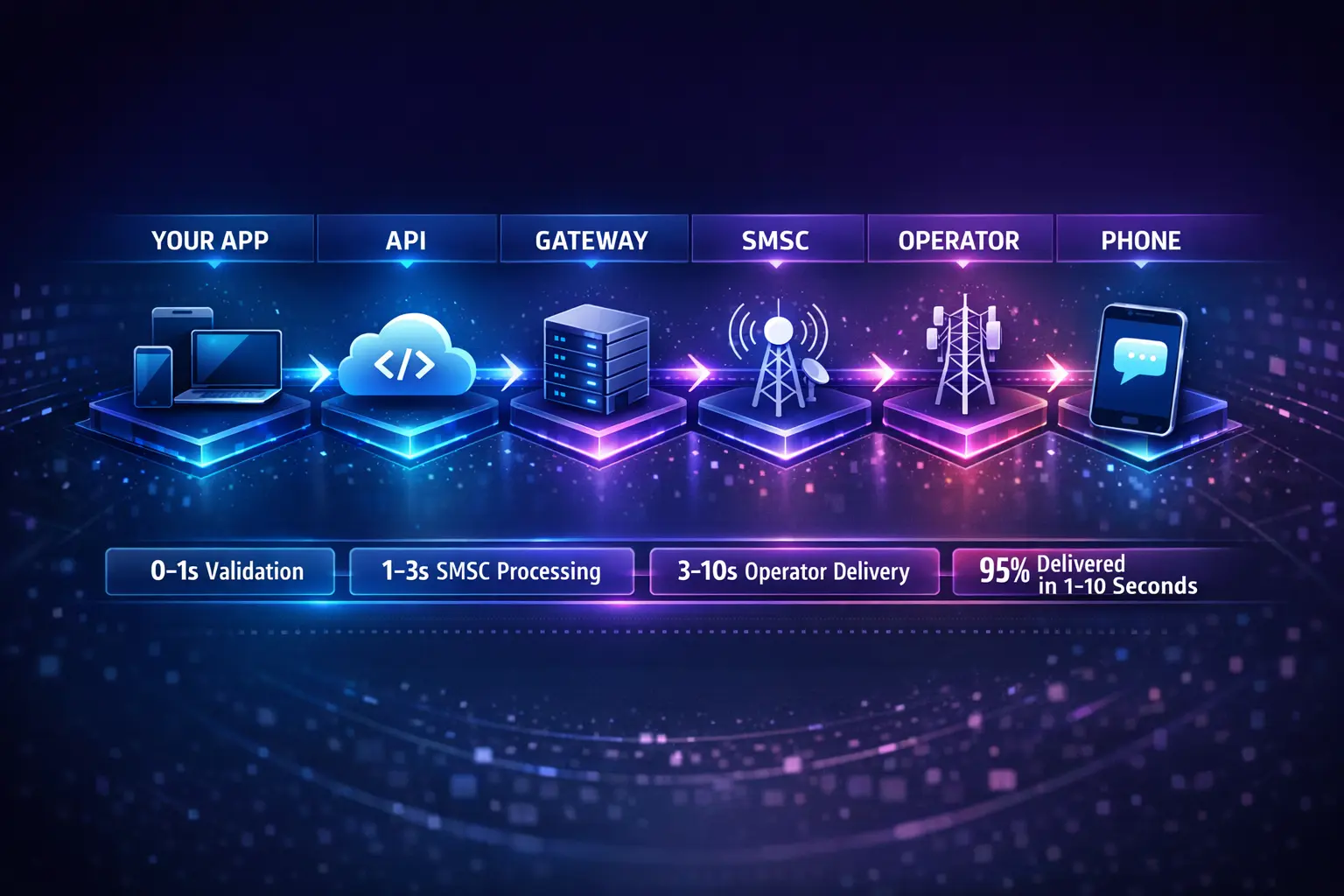
SMS gateways process messages through 6 distinct layers. Here's the complete journey:
Stage 1: Application Triggers Request
Your app (web, mobile, or backend service) initiates an SMS send. The request includes: recipient phone number, message content, sender ID, and optional metadata. This happens instantly when user action triggers SMS—like clicking 'Get OTP' button.
Example: User clicks 'Send OTP' → App generates 6-digit code → Calls SMS gateway API with phone number
Stage 2: API Request & Validation
SMS gateway receives HTTPS request and validates instantly:
• Is API key valid and not rate-limited?
• Is phone number in E.164 format (+91XXXXXXXXXX)?
• Is message within 160 characters?
• Is sender ID approved for this route?
Stage 3: Routing Engine Analysis
Gateway analyzes phone number's country code and operator prefix, then selects optimal route from its network:
Indian number +91 → Routes through Airtel/Jio/Vodafone SMSC → Selected based on: delivery success rate, speed, cost
Stage 4: SMSC Connection (SMPP Protocol)
Gateway connects to Short Message Service Center using SMPP—a binary protocol optimized for SMS. The gateway maintains persistent TCP connections to multiple SMSC servers for redundancy. Message transmits with routing info, then gateway waits for SMSC acknowledgment.
Typical latency: 200-500ms from API call to SMSC acceptance
Stage 5: Telecom Operator Network Routing
SMSC forwards message through operator's internal network using SS7 protocol. Network locates recipient's device using IMSI lookup, then transmits SMS over 4G/5G air interface. If recipient is offline, SMSC stores message and retries automatically every few minutes for 24-72 hours.
Typical latency: 2-8 seconds from SMSC to recipient device
Stage 6: Device Acknowledgment & Delivery Report
Device receives SMS and sends acknowledgment back to SMSC. SMSC generates delivery receipt and transmits to gateway. Gateway then notifies your app via webhook callback or returns status on polling. Entire flow completes in 1-10 seconds.
Total journey time: Typically 3-7 seconds from API call to delivery confirmation
Key Protocols Powering SMS Gateways
• HTTPS: Encrypts API communication between app and gateway. Protects API keys and phone numbers.
• SMPP: Binary protocol optimized for SMS. Gateway-to-SMSC communication. Maintains persistent TCP connections for high throughput.
• SS7: Telecom standard for network signaling. Used by operators internally for routing and subscriber lookups. Not directly used by gateways.
Integrating SMS API into Your Application
Most SMS gateways expose REST APIs accepting JSON payloads. Integration typically takes 15-30 minutes.
Basic API Request
POST https://api.smsgw.example.com/v1/sms/send Authorization: Bearer YOUR_API_KEY Content-Type: application/json { "recipient": "+919876543210", "message": "Your OTP is 156234", "sender_id": "OTPBANK", "route": "transactional" }
Success Response
HTTP 200 OK { "status": "submitted", "message_id": "msg_1234567890", "recipient": "+919876543210", "cost": 0.50 }
Common Error Responses
• 400 Bad Request: Invalid phone number format or missing fields
• 401 Unauthorized: Invalid API key or expired token
• 429 Too Many Requests: Rate limit exceeded. Implement exponential backoff retry.
• 500 Server Error: Gateway internal error. Retry with backoff.
Sender ID: Trust, Branding & Compliance
Sender ID is the text displayed in recipient's inbox—the "from" address. Critical for brand recognition and regulatory compliance.
Types of Sender IDs
• Numeric (10-digit phone): Enables two-way replies. Requires telecom approval. Best for customer support.
• Alphanumeric (brand name): Shows "PAYPAL", "AMAZON", etc. One-way only. Better brand visibility for alerts & marketing.
Transactional vs. Promotional
• Transactional: OTPs, confirmations, alerts. Zero restrictions. Highest priority routing.
• Promotional: Marketing, offers, events. Requires explicit consent. Restricted to 9 AM - 9 PM. Lower priority.
DLT Registration in India
TRAI mandates that every SMS sender register on National SMS Registry. Unregistered senders face blocking or suspension.
• Register entity on DLT portal
• Get sender ID approved (24-48 hours)
• For promotional SMS: Register message template (additional 24-72 hours)
SMS Routing: Direct vs. Grey Routes
Routing determines the path SMS takes through networks. This critical choice impacts cost, speed, compliance, and deliverability.
|
Criteria |
Direct Route |
Grey Route |
|
Connection |
Direct to operator SMSC |
Through 3rd-party aggregators |
|
Delivery Rate |
98-99% |
85-92% (unreliable) |
|
Speed |
1-3 seconds |
5-30 seconds variable |
|
Cost/SMS |
₹0.40-0.80 |
₹0.10-0.25 (false economy) |
|
Compliance |
TRAI-approved, audited |
Violates TRAI regulations |
⚠️ Grey routes are not compliant in India. Telecom operators actively block grey route senders. Using them risks account suspension and legal penalties.
Why Speed Matters
For OTP systems, 30-second delays cause user abandonment. Sub-3-second delivery converts 3-5% more users. Grey routes averaging 15-20 seconds lose customers at critical authentication moment.
Delivery Reports (DLR): Real-Time Tracking
DLR confirms whether SMS actually reached the recipient's phone. This differs from API acceptance—gateway accepting your request ≠ SMS delivered.
DLR Status Types
• Delivered: SMS reached recipient's device (2-5 seconds typical)
• Pending: In transit, waiting for confirmation
• Failed: Invalid number, network error, or blocked
• Expired: Queued for 24-72 hours but device never came online
Real-Time Webhook Notifications
Instead of polling, register a webhook URL. When delivery report arrives, gateway sends HTTP POST with status:
POST your.webhook.url/sms-callback { "message_id": "msg_1234567890", "status": "delivered", "recipient": "+919876543210", "timestamp": "2026-03-01T10:30:52Z" }
Using DLR for Analytics
• Track OTP success rate: 98% delivery = better conversion
• Identify problem routes: Monitor failure rates per operator
• Optimize routing: Switch providers if DLR shows consistent failures
• Cost optimization: Identify which routes waste money on failed messages
Security & Compliance
Encryption & Data Protection
• Always use HTTPS/TLS 1.2+. API keys in headers, never in URLs.
• Ensure provider has SOC 2 Type II, ISO 27001, or GDPR compliance.
• Never store phone numbers in plain text in your database.
TRAI Regulations (India)
• DLT registration mandatory for all senders
• Explicit consent required for promotional SMS
• Promotional SMS only 10 AM - 9 PM IST
• Violations: Message blocking, account suspension, legal action
Conclusion
SMS gateways handle the complex infrastructure that enables your OTP authentication, payment alerts, and customer notifications. From API validation through SMSC routing to delivery confirmation—every millisecond and handoff impacts user experience and conversion.
Budget SMS providers cut corners on routing quality, compliance, and infrastructure. Their lowest costs become expensive when:
• OTP failures during signup spike cause 3-5% conversion loss
• Account suspension for non-compliance damages reputation
• Slow delivery (15+ seconds) causes user abandonment
For mission-critical systems, invest in direct-route providers with 99.9%+ uptime, sub-2-second delivery SLA, and proven TRAI compliance. The reliability difference translates directly to revenue.
Frequently Asked Questions
Q: What's the typical cost per SMS?
Direct routes: ₹0.24-0.80 per SMS (India). Bulk discounts at 10k+ volume. Grey routes: ₹0.15-0.25, but frequent failures make them expensive overall.
Q: Can I improve delivery rates?
Yes: Use direct routes, maintain clean phone number lists, implement DLT registration, monitor DLR metrics for failures, and switch providers if rates consistently underperform benchmarks.
Q: How long should I retry failed SMS?
For OTP: Resend after 30 seconds if not delivered. For transactional alerts: 2-3 retries over 5 minutes. SMSC itself retries for 24-72 hours automatically.
Q: What's the DLT approval timeline?
Entity registration: 24-48 hours. Sender ID approval: 24-48 hours. Template approval (promotional): additional 24-72 hours. Banks and pre-registered entities: instant.
Q: Are SMS messages encrypted?
API communication uses HTTPS encryption. Content travels through telecom networks without end-to-end encryption. SMS is less secure than app-based messaging, but adequate for OTP + additional verification layers.
Ready to Build Reliable SMS Authentication?
Stop losing users to failed OTP delivery. Choose a direct-route SMS provider with TRAI compliance, 99.9% uptime guarantee, and sub-2-second delivery. Get started with compliant SMS gateway infrastructure today.
👉 Get Free DLT Support | 👉 Talk to Bulk SMS Expert | 👉 Start Sending SMS Now
Contact SMSGatewayHub:
📞 Call: +91-9907922122
📧 Email: support@smsgatewayhub.com
🌐 Visit: www.smsgatewayhub.com