Speed is everything in the OTP business. I've watched customers abandon their shopping carts, give up on bank transactions, and move to competitor apps simply because a verification code took too long to arrive. In the digital age, even a 30-second delay feels like an eternity.
So when businesses ask me why SMSGatewayHub consistently delivers OTP messages faster than most other Indian providers, the answer isn't just one thing. It's a combination of smart infrastructure choices, technical expertise, and understanding how Indian telecom networks actually work.


Direct Operator Connectivity Makes the Real Difference
Most SMS panels in India act as middlemen. Your OTP request goes through multiple hops before reaching the telecom operator. Each hop adds precious seconds to delivery time. SMSGatewayHub has established direct connections with all major Indian telecom operators – Airtel, Jio, Vi, and BSNL.
What does this mean practically? When you send an OTP through their system, it travels the shortest possible route to the recipient's phone. No unnecessary routing, no middleman delays. Just your message going straight from your server to the operator's network and then to your customer's device.
This direct connectivity isn't cheap or easy to set up. It requires significant investment in infrastructure and maintaining relationships with telecom operators. But the result is measurable – average delivery times of 2-4 seconds compared to 10-15 seconds or more with traditional SMS panels.
Smart Routing Based on Real-Time Network Conditions
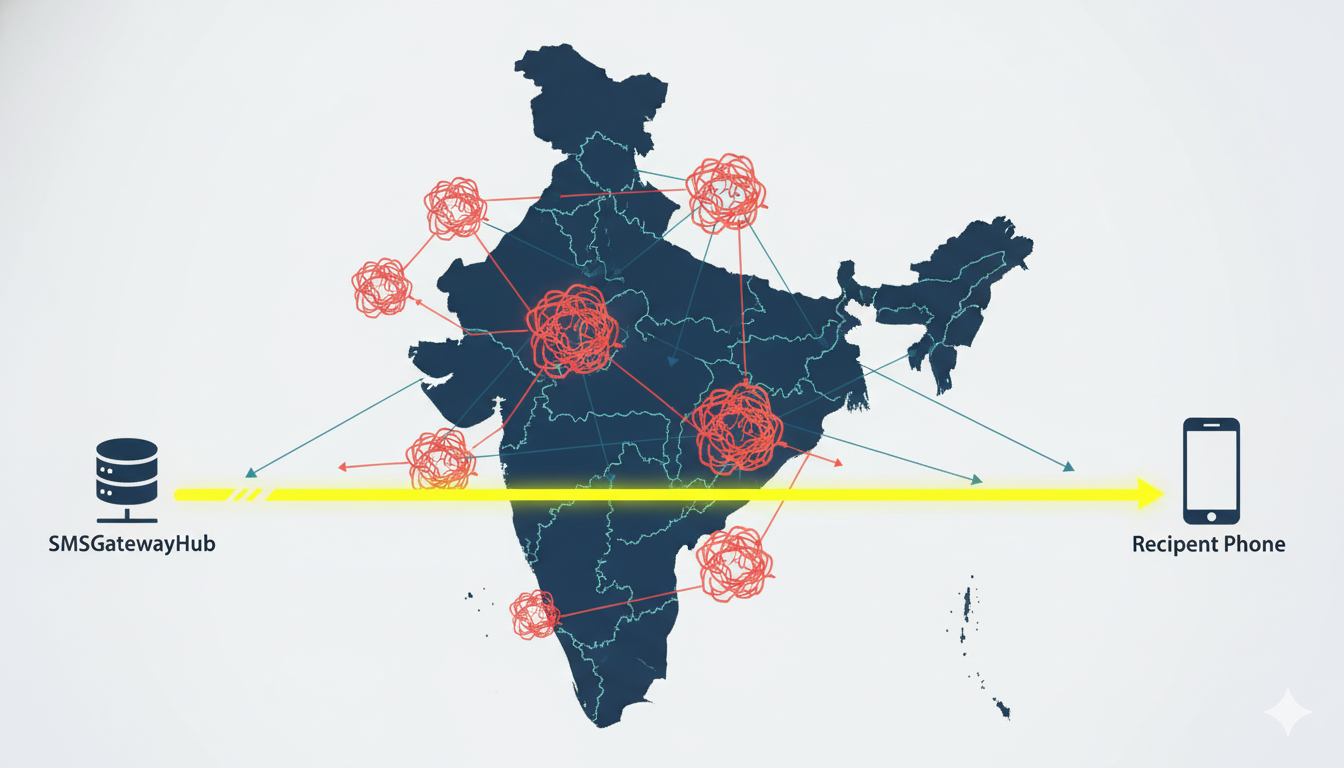
Indian telecom networks aren't uniform. At any given moment, one operator might be experiencing congestion in Maharashtra while another has perfect connectivity in the same region. SMSGatewayHub uses intelligent routing algorithms that monitor network conditions across operators in real-time.
When you send an OTP to a customer, their system automatically selects the fastest available route based on current network performance. If Airtel is experiencing delays in a particular circle, the system routes through an alternative operator connection. This dynamic routing happens in milliseconds and is completely invisible to you and your end user.
I've tested this during peak hours – festival seasons, IPL match times, New Year's Eve – when SMS traffic in India explodes. While other providers struggle with delays, SMSGatewayHub maintains consistent delivery speeds because their routing adapts to network realities.

Priority Queue Management for OTP Traffic
Here's something most people don't know about SMS gateways. Not all messages are treated equally in the queue. SMSGatewayHub maintains separate priority lanes for transactional OTP messages versus promotional content.
Your verification codes always get priority routing. They're never stuck behind bulk promotional campaigns or marketing blasts. This queue management ensures that time-sensitive OTP messages cut to the front of the line every single time.
The system also implements load balancing across multiple servers. During traffic spikes, incoming OTP requests are distributed across their server infrastructure to prevent bottlenecks. One server getting hammered with requests doesn't slow down your OTP delivery because the load is intelligently distributed.
Optimized API Architecture for Minimal Latency
Technical infrastructure matters more than people realize. SMSGatewayHub has built their API architecture with latency reduction as a primary goal. Their servers are hosted in multiple data centers across India, reducing the physical distance your API request needs to travel.
When your application makes an OTP request, it connects to the nearest server node. This geographic distribution cuts down on network latency significantly. A business in Bangalore connects to their South India servers, while a company in Delhi routes through North India infrastructure.
Their API is also incredibly lightweight. No bloated responses, no unnecessary data transfer, no complex authentication that adds processing time. You send a request, you get a confirmation, and your message is on its way. The entire API handshake typically completes in under 100 milliseconds.
Pre-Established Connections That Stay Warm
Many SMS providers establish fresh connections for each message batch. This connection setup time adds delays. SMSGatewayHub maintains persistent, pre-established connections with telecom operators.
Think of it like keeping your car engine running instead of restarting it every time you need to drive. Those warm connections mean your OTP messages start transmitting immediately without waiting for connection establishment, SSL handshakes, or authentication protocols to complete.
Redundancy Without Compromise
Speed and reliability usually come from the same source – good redundancy planning. SMSGatewayHub runs redundant systems for every critical component. Multiple servers, multiple operator connections, multiple data centers, multiple power supplies.
If one connection path experiences issues, traffic automatically fails over to backup routes without any delay in your OTP delivery. This redundancy architecture is expensive to maintain but crucial for consistent high-speed delivery.
I've seen situations where entire SMS panels went down during operator maintenance windows. SMSGatewayHub customers didn't even notice because their messages automatically rerouted through alternative connections.
Continuous Performance Monitoring and Optimization
Speed isn't a set-it-and-forget-it achievement. SMSGatewayHub employs dedicated network engineers who monitor delivery performance around the clock. They track delivery speeds by operator, by region, by time of day, and by message type.
This data drives continuous optimization. If they notice delivery times creeping up in a particular region, they investigate and fix it before it becomes a problem for customers. This proactive approach to performance management keeps their delivery speeds consistently ahead of competitors.
The Proof Is in Delivery Reports
SMSGatewayHub provides detailed delivery reports with timestamps down to the second. You can see exactly when your OTP was submitted, when it was accepted by the operator, and when it was delivered to the handset. This transparency allows you to verify their speed claims with your own data.
When I compare these delivery reports with other providers I've tested, the difference is clear. Average delivery times are consistently 3-5 times faster with SMSGatewayHub, especially during peak traffic periods when speed matters most.
Why This Speed Matters for Your Business
Faster OTP delivery directly impacts your bottom line. Every second of delay increases the chance of transaction abandonment. Studies show that conversion rates drop by 7-10 percent for every additional 10 seconds users wait for verification codes.
For an e-commerce business processing thousands of transactions daily, those seconds translate to real revenue. For a banking app, speed means better customer satisfaction scores. For any application requiring user verification, faster OTPs mean smoother user experiences and fewer support tickets.
Moving Beyond Marketing Claims
Every SMS provider claims to be fast. The difference with SMSGatewayHub is that their speed advantage comes from genuine infrastructure investment rather than marketing language. Direct operator connections, intelligent routing, priority queuing, optimized APIs, and redundant architecture – these aren't buzzwords, they're engineering decisions that cost money but deliver measurable results.
If OTP delivery speed matters to your business – and it should – the technical approach SMSGatewayHub has taken deserves your attention. They've built their system from the ground up with speed as a core design principle, not an afterthought.