What is OTP & How Secure OTP Delivery Works? Complete Guide for Indian Businesses

Introduction: Why OTP is Critical in India's 2026 Digital Economy
India's digital payment ecosystem is experiencing unprecedented growth. With over 500 million UPI transactions monthly (as of 2025) and the fintech sector expanding at 35% annually, secure authentication has become non-negotiable.
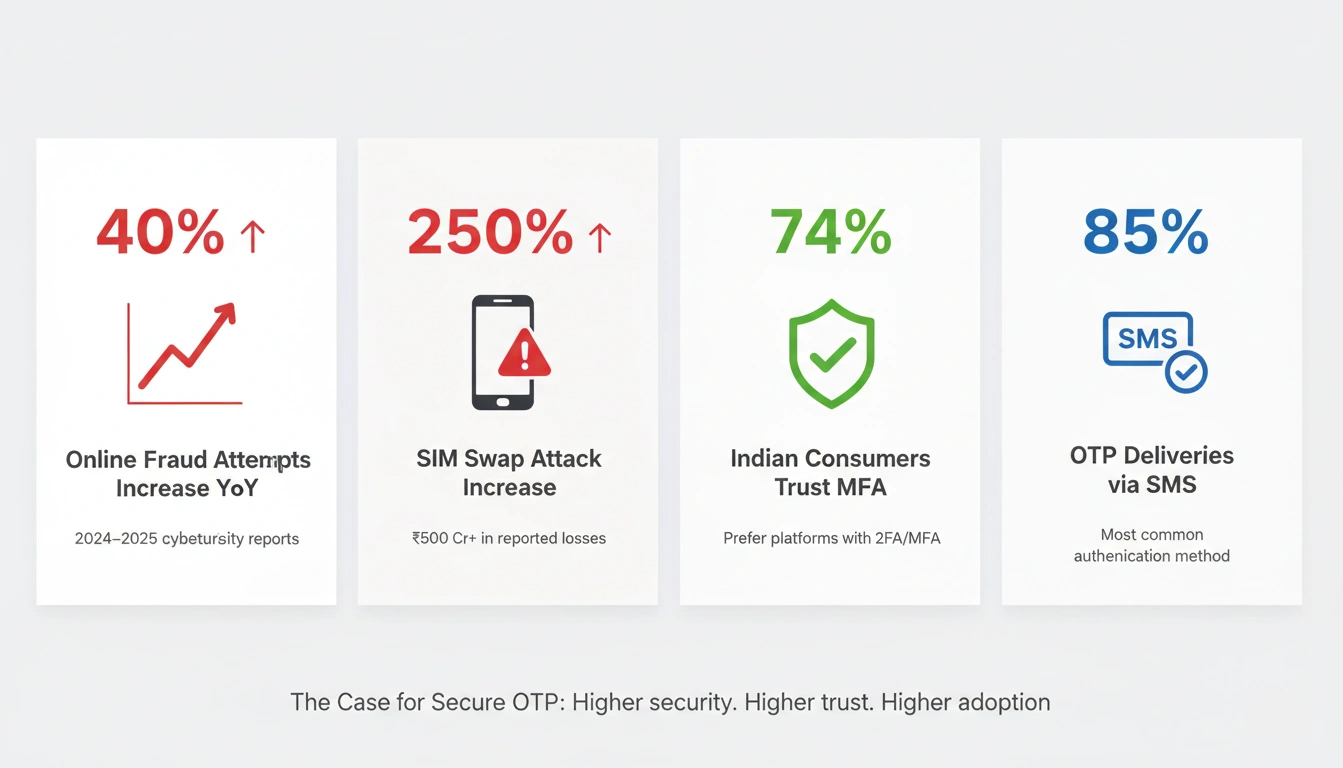
However, this explosive growth comes with a darker reality: online fraud attempts have increased by 40% year-over-year. From SIM swap attacks to phishing exploits, cybercriminals are constantly evolving their tactics to compromise user accounts and steal sensitive financial data.
This is where One-Time Passwords (OTPs) stand as the first line of defense.
For Indian businesses—whether you're running an eCommerce platform, a fintech startup, an NBFC, or a SaaS application—implementing a secure OTP delivery system isn't just a compliance requirement; it's a trust-building necessity. According to recent cybersecurity reports, 74% of Indian consumers trust platforms that enforce multi-factor authentication, and OTP remains the most accessible form.
But here's the critical question: Is your OTP delivery truly secure?
In this guide, we'll break down how OTP works, the science behind secure delivery, common security threats, and why choosing the right OTP provider can be the difference between safeguarding your users and becoming a cybersecurity headline.
👉 Get Free DLT Support | 👉 Talk to Bulk SMS Expert | 👉 Start Sending SMS Now
Contact SMSGatewayHub:
📞 Call: +91-9907922122
📧 Email: support@smsgatewayhub.com
🌐 Visit: www.smsgatewayhub.com
What is OTP? Definition & Core Concepts
An One-Time Password (OTP) is a unique, time-sensitive numeric or alphanumeric code generated specifically for a single transaction or login attempt. Unlike static passwords, OTPs are valid for only 30–120 seconds and cannot be reused, making them exponentially more secure.
Think of it this way: A static password is like a house key that works indefinitely. An OTP is like a temporary access pass that self-destructs after use.
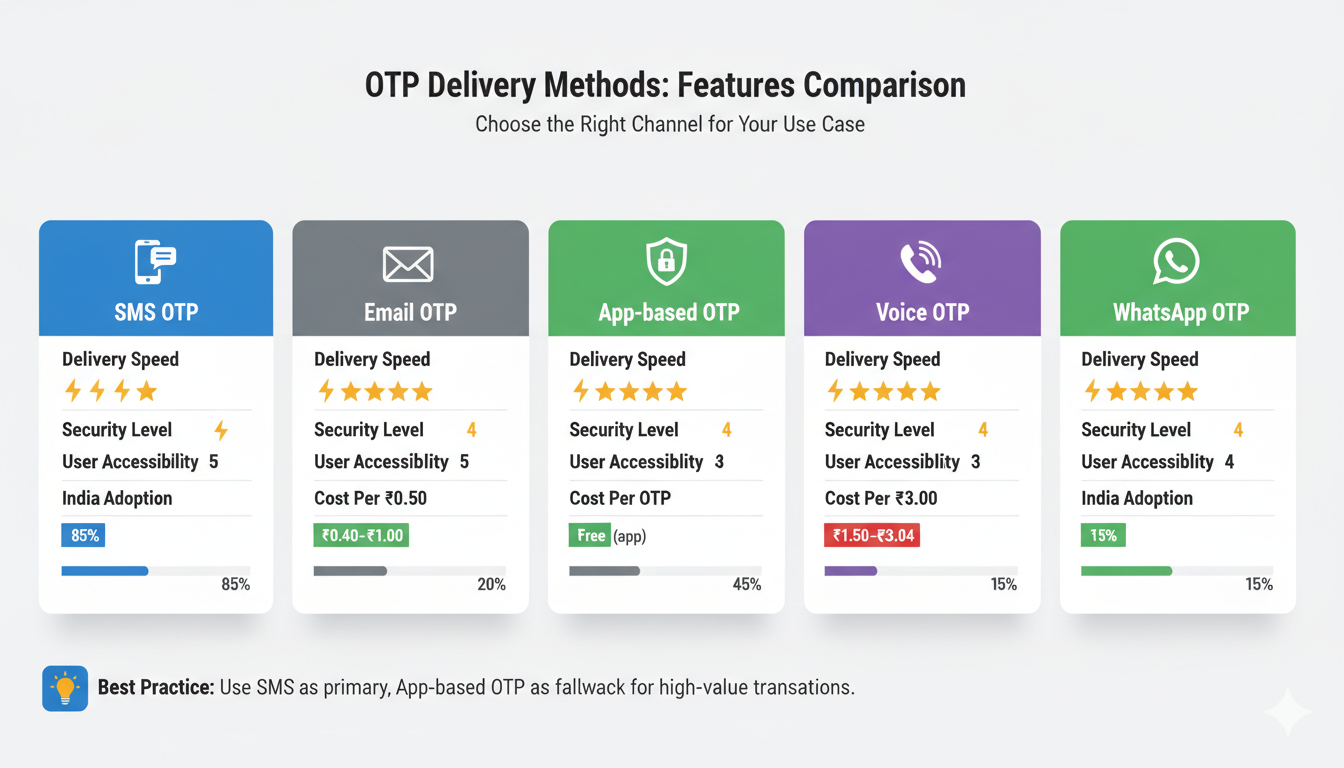
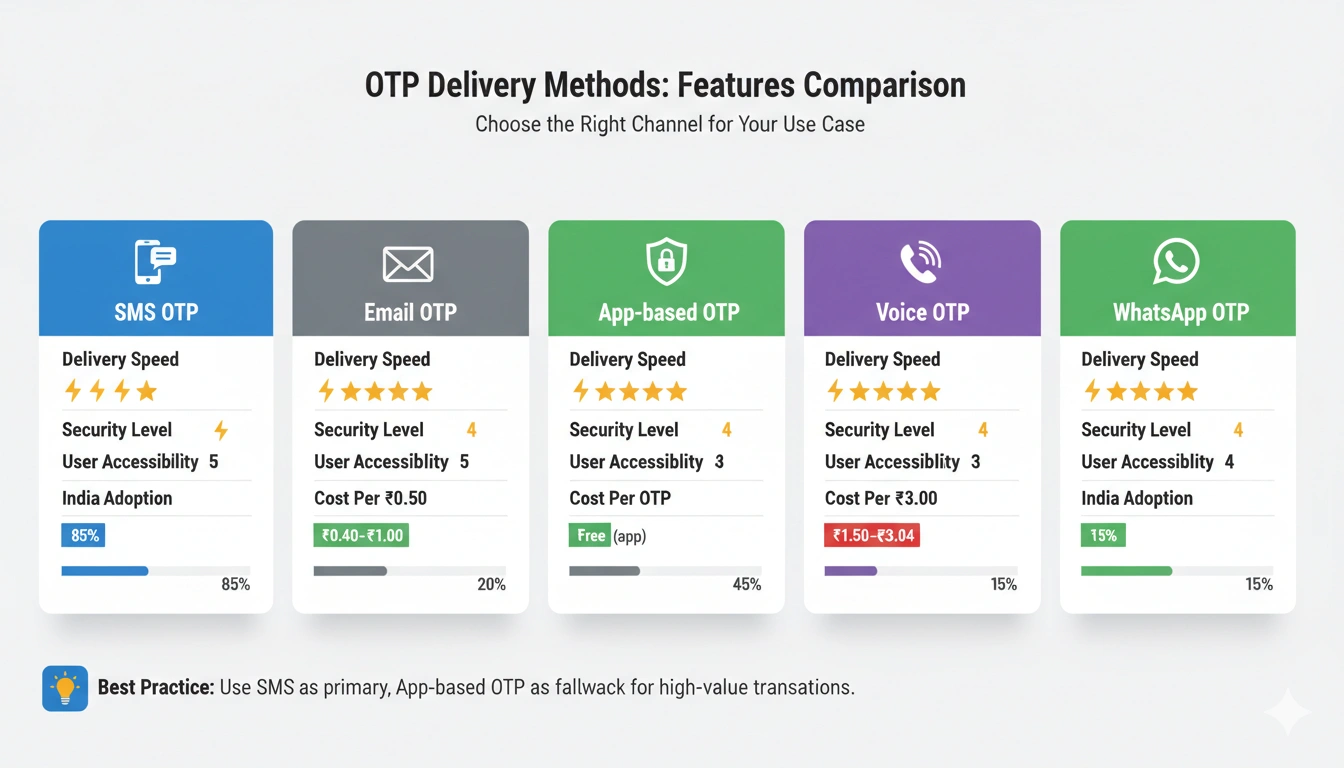
Types of OTP Delivery Methods
Indian businesses leverage multiple OTP channels, each with distinct advantages:
1. SMS OTP (Most Common)
- Delivered via SMS gateway to user's mobile number
- Requires only basic phone access (no internet needed)
- Adoption in India: 85% of OTP deliveries are SMS-based
- Best for: Banking, eCommerce, digital payments
- Latency: 1–5 seconds average delivery time
2. Email OTP
- Sent to user's email address
- Suitable for web-based applications
- Slower delivery compared to SMS (3–10 seconds)
- Better for secondary verification layers
3. App-Based OTP (Time-based)
- Generated within authenticator apps (Google Authenticator, Microsoft Authenticator)
- No internet dependency; works offline
- Highest security standard (TOTP – Time-based One-Time Password)
- Ideal for: Banking apps, crypto exchanges, high-value transactions
4. Voice OTP
- Automated voice call reading out the OTP code
- Accessible for users without smartphones
- Delivery time: 5–15 seconds
- Compliance advantage for accessibility requirements
5. WhatsApp OTP
- Emerging trend in India; delivered via WhatsApp Business API
- Leverages encrypted messaging infrastructure
- Growing adoption: 15% increase in WhatsApp OTP usage (2024–2025)
- Advantage: Higher open rates (~95%) compared to SMS (~70%)
How OTP Works: A Step-by-Step Process
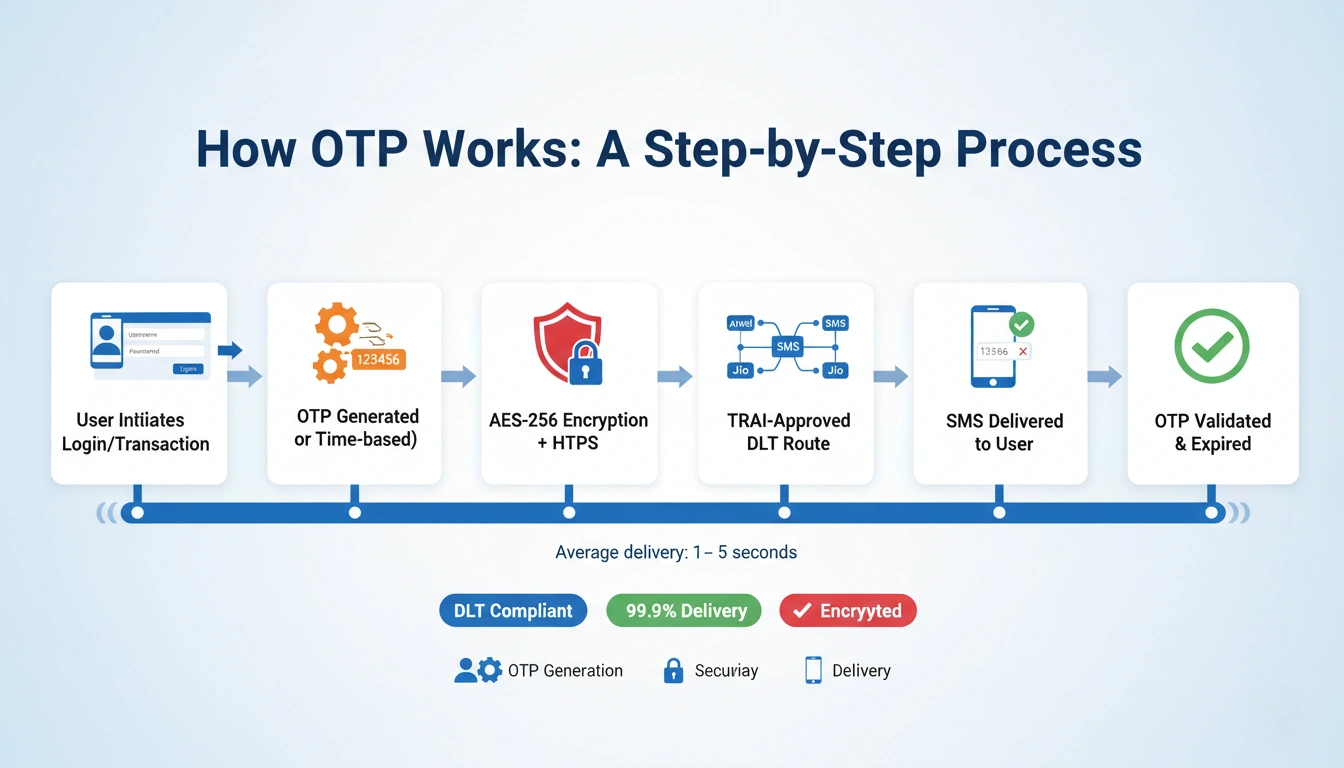
Understanding the OTP generation and delivery flow is essential for businesses implementing secure authentication.
Step 1: User Initiates Request
A user attempts to log in to your application or initiate a sensitive transaction (fund transfer, password reset, account creation).
Step 2: OTP Generation
Your application triggers an OTP generation algorithm. There are two primary methods:
- Random Algorithm: Generates a random 4–6 digit code using cryptographically secure random number generators (harder to predict)
- Time-based Algorithm (TOTP): Uses synchronized time between user's device and server to generate codes valid for 30–60 second windows (industry standard for apps)
Security Note: The OTP is never stored in plain text. Instead, a hashed version is temporarily stored in your database with an expiration timestamp.
Step 3: Encryption & API Transmission
The generated OTP is encrypted using AES-256 encryption and transmitted via HTTPS (TLS 1.2 or higher) to the SMS/Email gateway API. This ensures the code remains hidden from interception during transit.
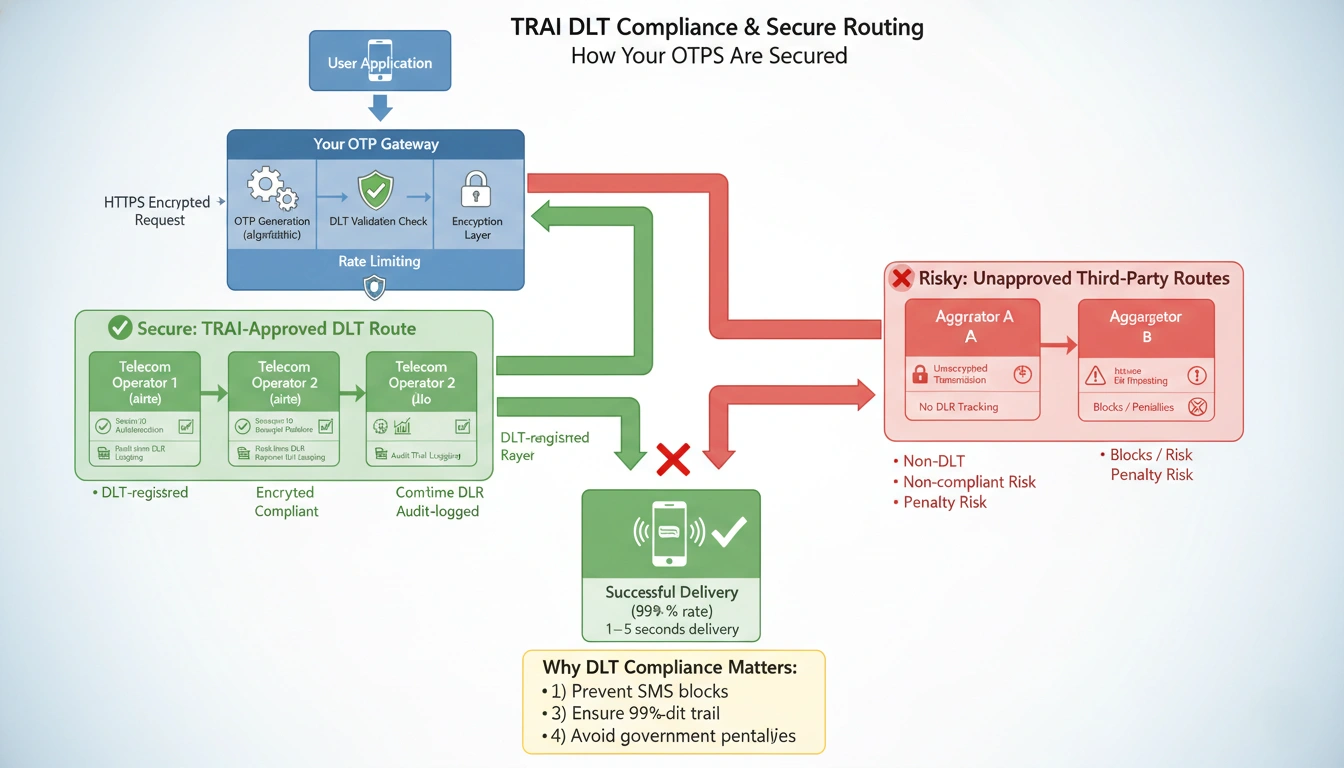
Step 4: Gateway Routing & DLT Compliance
In India, all SMS communications must route through TRAI-approved Direct Long Code (DLT) channels. A compliant OTP gateway routes your message through registered telecom operators (Airtel, Jio, Vodafone, etc.) using:
- Registered Sender ID: Identifies your business
- DLT Template: Pre-registered message format with TRAI
- Telecom Routing: Direct connection to telecom networks for minimum latency
Step 5: SMS Delivery
The SMS travels through telecom infrastructure in milliseconds, reaching the user's phone with 99%+ delivery rate on compliant gateways.
Step 6: Validation & Expiration
The user enters the OTP within the expiry window (typically 30–120 seconds). Your system validates the code against the hashed value stored in the database. Upon validation:
- The OTP is immediately deleted from your system
- Subsequent OTP requests for the same transaction are rejected (rate-limited)
- The user gains access or completes the transaction
Trending Related Posts -Best SMS Gateway in India – Why SMSGatewayHub is Trusted
How Secure OTP Delivery Works: The Technical Architecture
Secure OTP delivery isn't just about sending a code; it's about building a fortified pipeline resistant to modern cyber threats.
1. End-to-End Encryption
All communication between your application and the OTP gateway must use HTTPS with TLS 1.2 minimum. The OTP payload is encrypted client-side and decrypted only at the gateway's secure endpoint.
2. Direct Telecom Routing (DLT)
Rather than routing through third-party SMS aggregators, certified OTP gateways maintain direct connections with telecom operators. This eliminates intermediary nodes where interception could occur.
India's DLT Mandate:
- All SMS OTPs must be routed through TRAI-registered gateways
- Violating DLT compliance results in SMS blocks and government penalties
- DLT-approved routing provides audit trails and delivery reports
3. Sender ID Authentication
Your registered Sender ID is cryptographically authenticated during transmission, proving to the telecom operator (and the user) that the SMS originates from your legitimate business account.
4. Real-Time Delivery Reports (DLR)
Secure gateways provide Delivery Receipts (DLR) with status codes:
- 1: Delivered successfully
- 2: Failed delivery (invalid number)
- 5: Rejected by telecom (DLT non-compliance)
- 8: System error on gateway
These reports allow you to detect failed deliveries in real-time and trigger alternative verification methods.
5. Failover Routing
If primary SMS delivery fails, secure gateways automatically route through backup telecom operators or alternative delivery channels (Email OTP, WhatsApp OTP) to ensure user experience remains uninterrupted.
6. Rate Limiting & Fraud Detection
Legitimate gateways implement server-side protections:
- Limit OTP requests: Maximum 3–5 OTP requests per phone number per hour
- IP Tracking: Flag and block suspicious request patterns from unusual geographic locations
- Velocity Checks: Detect rapid-fire OTP requests indicating brute force attempts
- Device Fingerprinting: Compare incoming requests against known user devices
Start messaging today - Developer SMS API Free SMS Gateway Developer API
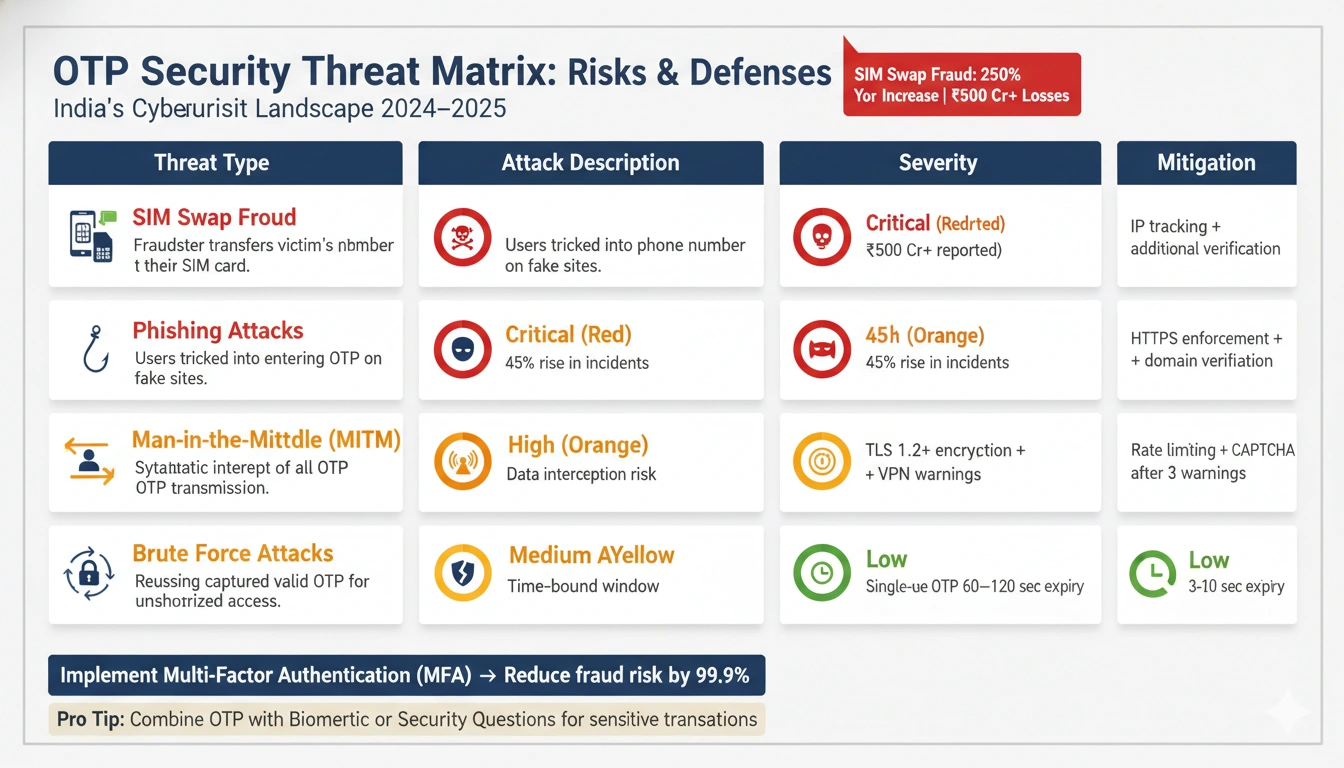
Common OTP Security Threats & Vulnerabilities
Despite OTP's robustness, cybercriminals have developed sophisticated attack vectors targeting the OTP ecosystem.
1. SIM Swap Fraud
Attack: Fraudsters convince telecom customer service to transfer a victim's phone number to a SIM card under attacker's control. The attacker then requests OTPs for the victim's accounts.
Reality in India: SIM swap attacks increased by 250% in 2024, with reported losses exceeding ₹500 crore across fintech and banking platforms.
Defense: Implement IP-based fraud detection and require additional verification for sensitive operations (fund transfers above ₹50,000).
2. Phishing Attacks
Attack: Users are tricked into entering OTPs on fake login pages or fake SMS links. The attacker then uses the OTP to compromise the real account.
Defense: Educate users to verify domain names; implement DNS security and HTTPS enforcement.
3. Man-in-the-Middle (MITM) Attacks
Attack: Attackers intercept unencrypted OTP transmission between your server and the SMS gateway.
Defense: Always use HTTPS with TLS 1.2+; never send OTPs over plain HTTP.
4. Brute Force Attacks
Attack: Cybercriminals systematically try all possible OTP combinations (000000–999999 for 6-digit OTPs).
Defense: Implement rate limiting, exponential backoff (increasing delays between attempts), and CAPTCHA after 3 failed attempts.
5. Replay Attacks
Attack: Attackers capture a valid OTP and reuse it for unauthorized access.
Defense: OTPs are single-use by design and expire after 60–120 seconds. Ensure your system immediately invalidates used OTPs.
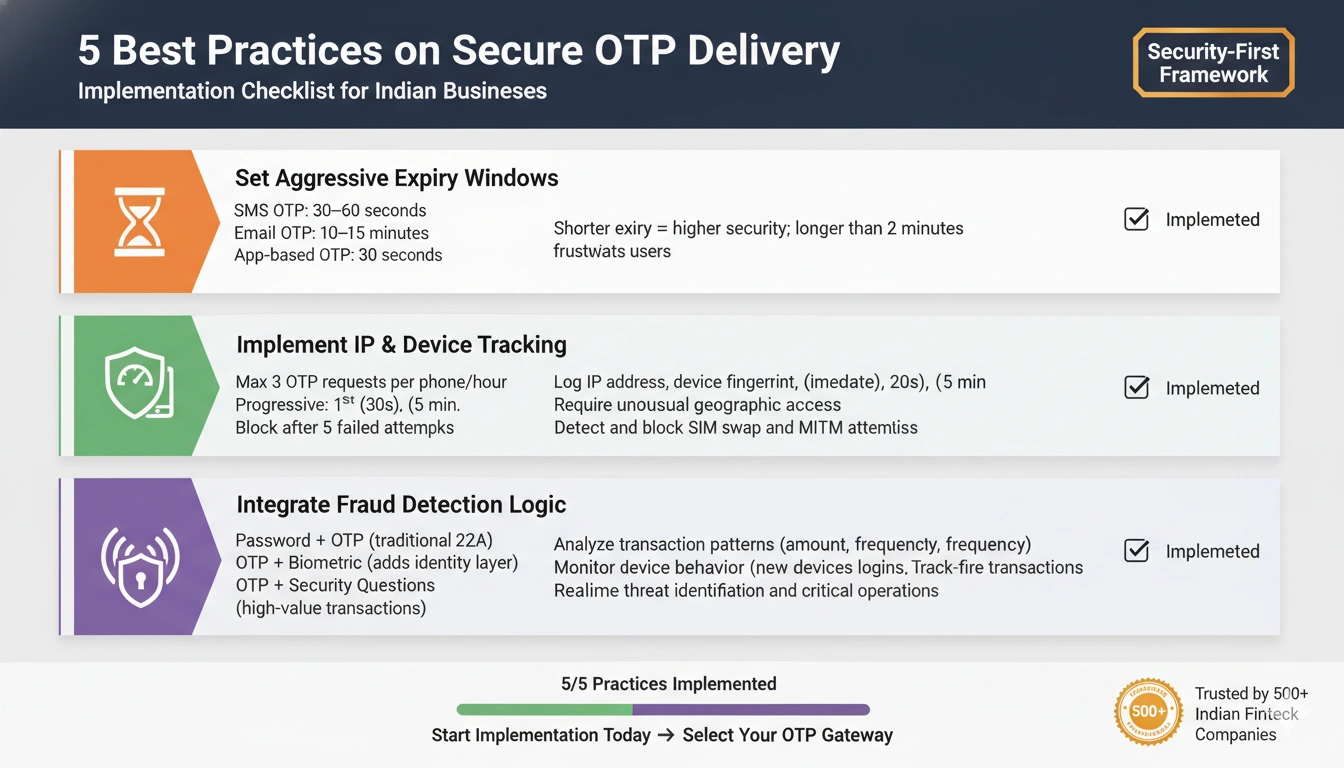
Best Practices for Secure OTP Delivery
Implementing OTP isn't just about integration; it's about building defense-in-depth security architecture.
1. Set Aggressive Expiry Windows
- SMS OTP: 30–60 seconds (users have enough time; attackers don't)
- Email OTP: 10–15 minutes (slower delivery justifies longer windows)
- App-based OTP: 30 seconds (synchronized time-based codes)
Rule: Shorter expiry = higher security, but longer than 2 minutes frustrates users.
2. Implement Rate Limiting
- Maximum 3 OTP requests per phone number per hour
- Progressive delays: 1st attempt (immediate), 2nd attempt (30 sec delay), 3rd attempt (5 min delay)
- Block after 5 failed attempts within 1 hour
3. Enable IP & Device Tracking
- Log the IP address, device fingerprint, and geographic location of OTP requests
- Flag requests from unusual locations (e.g., international IP accessing Indian bank account)
- Require additional verification for unusual access patterns
4. Integrate Fraud Detection Logic
Partner with fraud detection APIs that analyze:
- Transaction patterns (unusual amounts, frequencies)
- Device behavior (new devices, multiple logins)
- Velocity metrics (rapid-fire transactions)
5. Enforce Multi-Factor Authentication (MFA)
Don't rely solely on OTP. Combine with:
- Password + OTP: Traditional 2FA
- OTP + Biometric: Adds identity verification layer
- OTP + Security Questions: For high-value transactions (e.g., fund transfers)
Why Businesses Need a Reliable OTP SMS Provider in India
Choosing the right OTP provider isn't a commodity decision—it's a critical infrastructure investment.
What Separates Premium OTP Providers from Basic Alternatives?
99%+ Delivery Rate (vs. 85–90% industry average)
- Direct telecom partnerships ensure fastest routing
- Automatic failover to backup operators
- Real-time monitoring of delivery success
Instant API Integration
- RESTful APIs with extensive documentation
- Sandbox environments for testing
- SDKs for popular frameworks (Node.js, Python, Java, PHP)
- 15–30 minute integration vs. days with traditional providers
Sub-Second Latency Routing
- Direct telecom connections (no third-party aggregators)
- Geographically distributed servers (North, South, East, West India)
- Average delivery: 1–2 seconds (vs. 3–5 seconds for basic providers)
TRAI DLT Compliance & Pre-Registered Templates
- Pre-registered DLT templates for OTP delivery
- Automatic compliance auditing
- Zero risk of SMS blocks due to non-compliance
Real-Time Delivery Reports & Analytics
- Instant DLR notifications via webhooks
- Detailed delivery analytics dashboard
- Failure reason codes for debugging
24/7 Technical Support
- Dedicated account managers for enterprise clients
- Technical support in Hindi and English
- Quick resolution SLAs (15 minutes for critical issues)
Conclusion: OTP as the Backbone of Digital Trust
In 2026, OTP has evolved from a nice-to-have security feature to a foundational requirement for any business handling user authentication or financial transactions.
The statistics are clear: Indian consumers demand security, regulators mandate it, and cybercriminals are constantly probing for weaknesses. Whether you're a fintech startup processing ₹10 crore in monthly transactions or an eCommerce platform scaling to millions of users, your OTP delivery infrastructure is only as strong as its weakest link.
The decision to invest in a reliable, TRAI-compliant, high-delivery OTP SMS provider isn't a cost—it's an insurance policy against fraud, a trust signal to your customers, and a compliance safeguard against regulatory penalties.
Your users trust you with their data. Secure OTP delivery ensures that trust is never broken.
Frequently Asked Questions (FAQs)
Q1: What's the difference between SMS OTP and app-based OTP? Which is more secure?
SMS OTP is user-friendly and doesn't require app installation, making it ideal for onboarding. However, app-based OTP (TOTP) is technically more secure because it uses time-synchronization algorithms that can't be intercepted like SMS messages. For maximum security, use app-based OTP for sensitive operations and SMS OTP as a fallback.
Q2: Is OTP delivery GDPR and India's Digital Personal Data Protection (DPDP) compliant?
Yes, if implemented correctly. OTPs don't store personal data—they're temporary codes. However, you must encrypt OTP transmission, log access securely, and comply with data retention periods. Under India's DPDP Act (2023), you must minimize personal data collection and implement security safeguards, both of which OTP inherently supports.
Q3: Why do some OTPs fail to deliver, and how do I reduce delivery failures?
Common reasons: invalid phone numbers, DLT non-compliance, telecom network congestion, SIM swap, or user's network settings blocking SMS. To reduce failures: validate phone numbers, use DLT-approved gateways, implement automatic retries with failover to email/WhatsApp, and partner with providers offering 99%+ delivery guarantees.
Q4: Can OTP be hacked or intercepted despite being "secure"?
OTP itself is secure, but the delivery channel (SMS) is theoretically interceptable. However, the combination of short expiry (30–60 seconds), single-use design, and rate limiting makes practical exploitation nearly impossible. The real risk is not interception but SIM swap fraud, phishing, and user error. Mitigate these with multi-factor authentication and user education.
Q5: What's the cost difference between SMS OTP and WhatsApp OTP?
SMS OTP typically costs ₹0.24–₹.40 per message. WhatsApp OTP costs ₹0.50–₹1.50 per message but offers higher delivery rates (~95%) and engagement. For high-volume use cases (eCommerce), SMS is cost-effective. For premium services (banking, crypto), WhatsApp OTP's higher reliability justifies the marginal cost increase.
Take Action: Secure Your Users Today
Your business's reputation depends on secure authentication. Don't compromise on OTP delivery quality.
Partner with a TRAI-compliant, high-delivery OTP provider that understands the Indian regulatory landscape and delivers sub-second latency.
Get 99%+ Delivery Rate with Our OTP Gateway - Start Free Trial
This guide is written by SMSgatewayHub - India's trusted bulk SMS service provider since Oct 2010.
We send 1000 million+ Bulk Sms daily to protect Indian citizens and businesses.
Need help with DLT registration? 📞 Call: +91-9907922122 📧 Email: support@smsgatewayhub.com
To Find Related Articles-
Best Bulk SMS Provider by City
- Best Bulk SMS Service in Chennai
- Get the Best Bulk SMS Provider in Mumbai
- Affordable Bulk SMS Services in Delhi
- Best Bulk SMS Service Provider in Bangalore
- Best SMS Service Provider in Noida
- Best Bulk SMS Service Provider in Jaipur
Best Bulk SMS Provider by Industry
- Best Bulk SMS Service Providers in India for Educational Institutes
- Best SMS Marketing Solutions for Healthcare Providers in India
- Bulk SMS Services for Transport Industry
- Bulk SMS Service for Logistics
- Improve Life Insurance Retention
- Real Estate Lead Generation with Bulk SMS India
- Bulk SMS for Schools