Choosing a Bulk SMS Provider in India: What the Industry Won't Tell You in 2026
A retail chain owner from Pune reached out to me last week, furious. He'd spent ₹1.8 lakhs on bulk SMS campaigns over three months with what seemed like a reputable provider. The dashboard showed 95% delivery rates. Sales barely moved. When we audited his campaigns, we discovered something shocking—his messages were being delivered, but with 18-25 second delays. Customers received his "flash sale ending in 30 minutes" alerts after the sale had already ended.
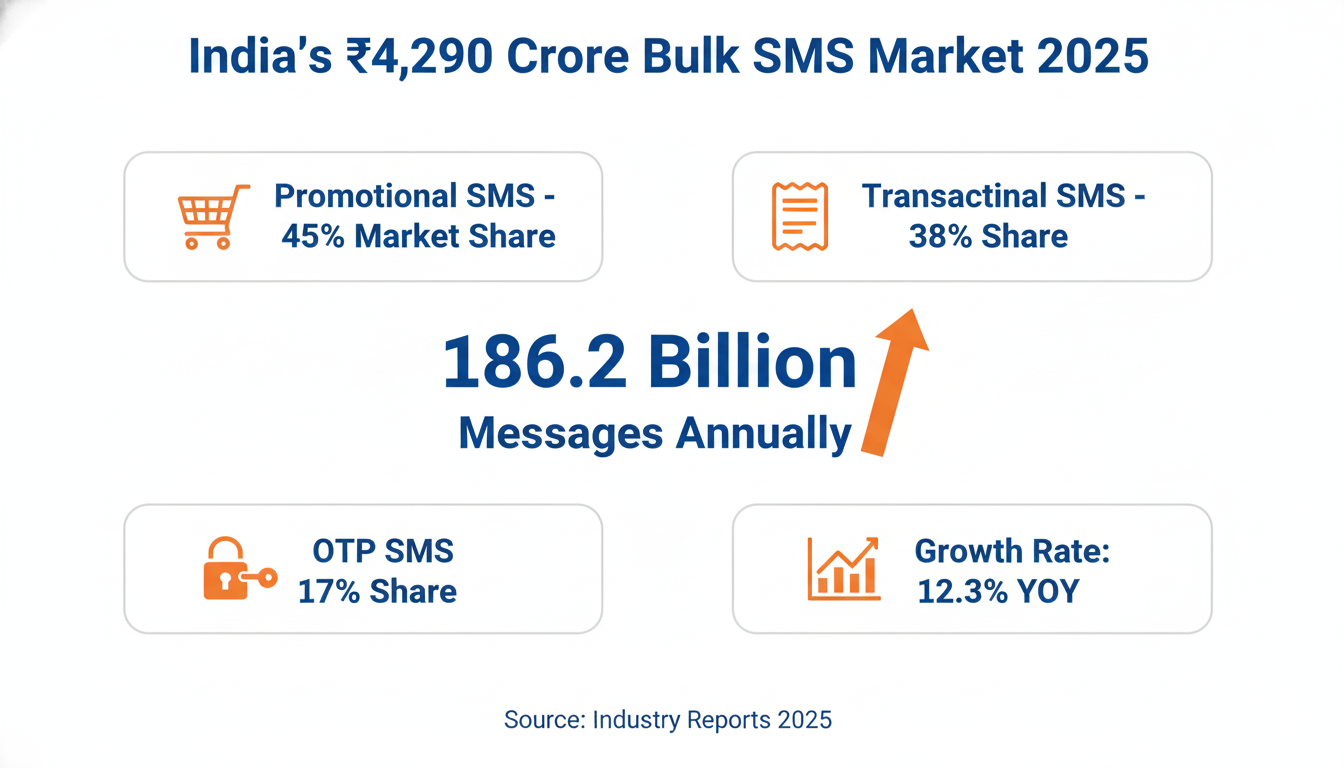
This scenario plays out daily across India. The bulk SMS service provider market in India reached ₹4,290 crores in 2025, processing 186.2 billion messages annually. Yet most businesses choose providers based on per-message pricing without understanding the mechanics that actually determine campaign success or failure.
The gap between what providers advertise and what they deliver has never been wider. While everyone promises instant delivery and high success rates, the reality involves routing complexity, regulatory compliance challenges, and hidden cost structures that most businesses discover only after signing contracts and experiencing failures.



Understanding the Real Bulk SMS Market in India
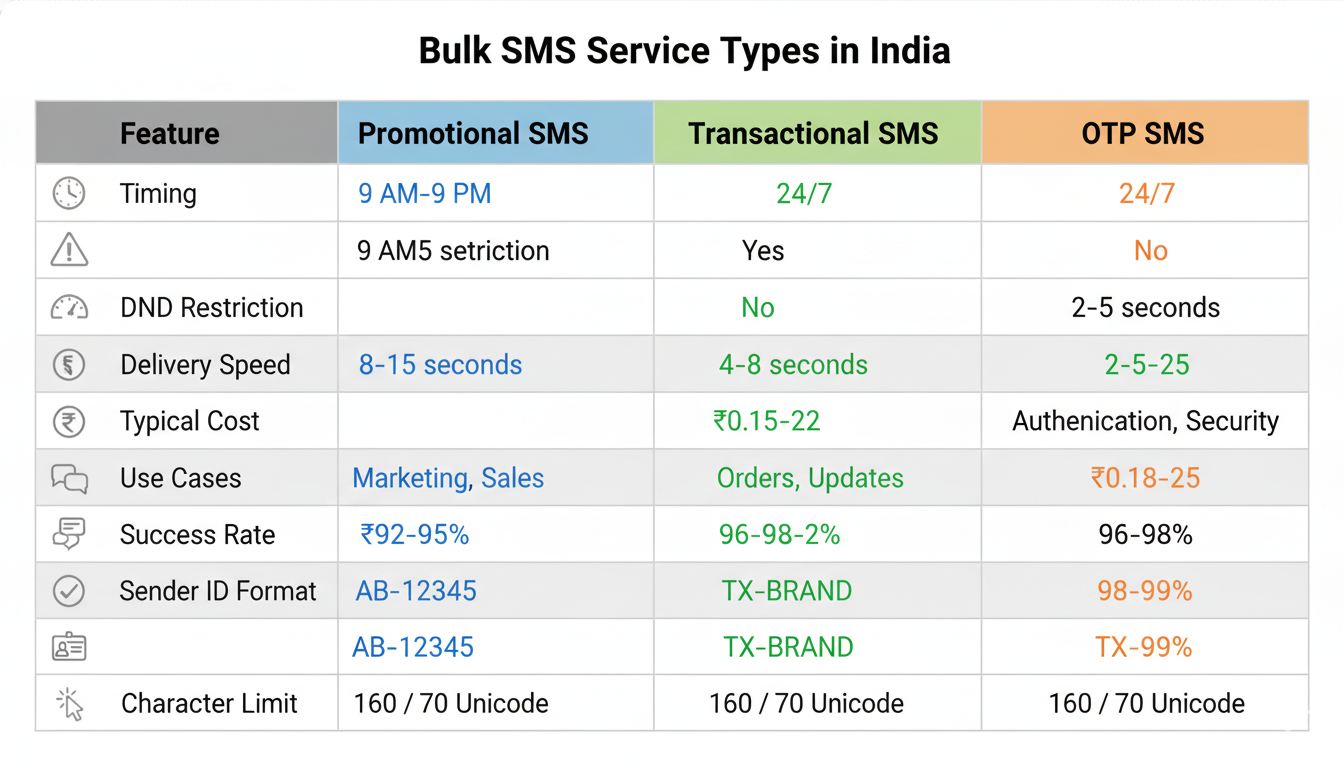
India's bulk SMS landscape operates in three distinct segments, each with different pricing, regulations, and use cases. Understanding these differences prevents costly mistakes when selecting a bulk SMS service provider in India.
Promotional SMS targets customers with marketing messages, offers, discounts, and announcements. These messages can only be sent between 9 AM and 9 PM, Monday through Sunday, as per TRAI regulations. They respect DND registrations unless customers specifically opt in for your brand. Promotional bulk SMS service providers typically charge ₹0.12-0.18 per message, making this the most cost-effective option for marketing campaigns.
Transactional SMS delivers order confirmations, OTP codes, payment receipts, shipping updates, and account notifications. These messages operate 24/7 without time restrictions and bypass DND registers because they're providing information customers actively expect. A transactional SMS service provider charges slightly more—₹0.15-0.22 per message—due to premium routing requirements and higher delivery guarantees.
OTP SMS service represents a specialized subset requiring the fastest possible delivery and highest security. Banking apps, payment gateways, and authentication systems depend on these codes arriving within 3-5 seconds. The best OTP SMS service provider in India maintains direct operator connections specifically optimized for this critical use case, with pricing around ₹0.18-0.25 per message.
The distinctions matter more than most businesses realize. Mixing promotional content into transactional messages violates TRAI regulations, risking sender ID blacklisting. Using a promotional SMS provider for OTP delivery results in unacceptable delays that frustrate users and kill conversions.
Why Bulk SMS Rate in India Varies More Than You Think
When businesses ask about bulk SMS price in India, they expect straightforward answers. Instead, pricing operates through complex variables that can double or triple your actual costs if you're not careful.
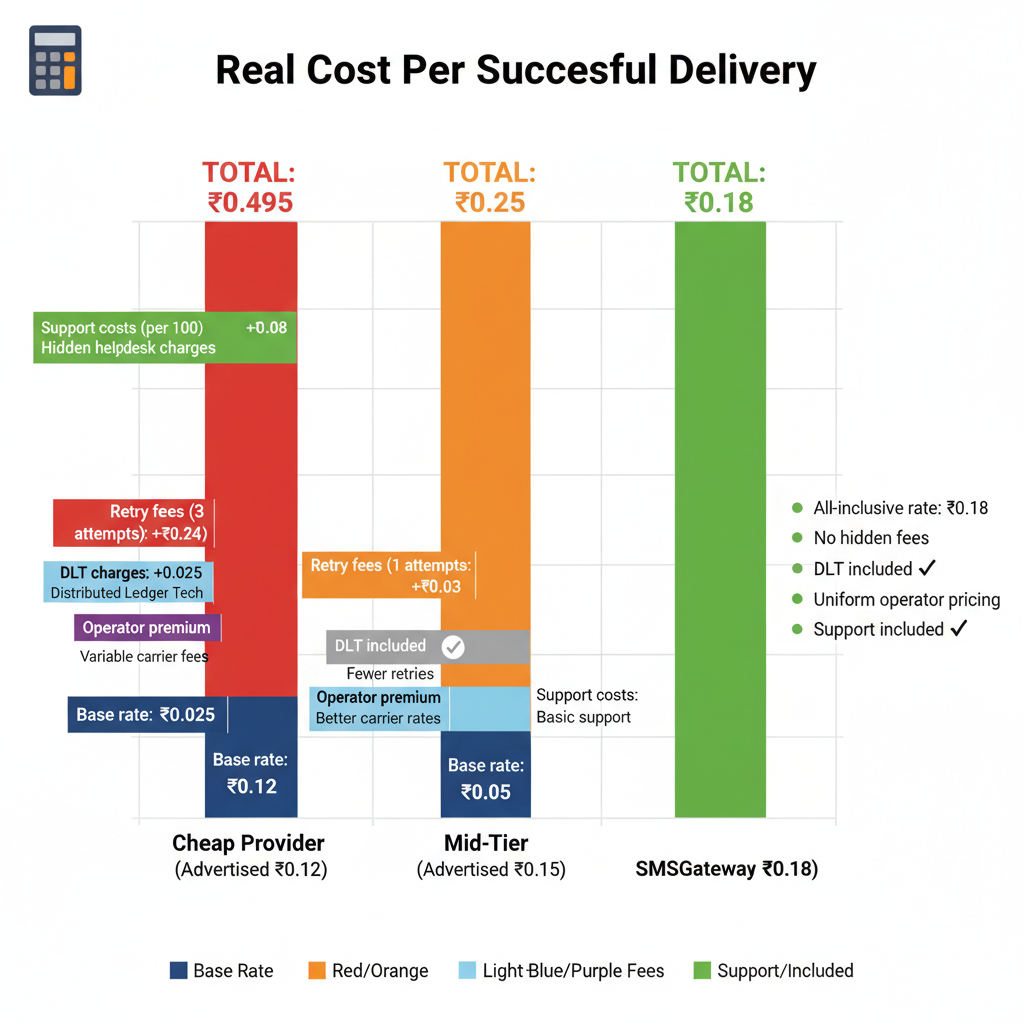
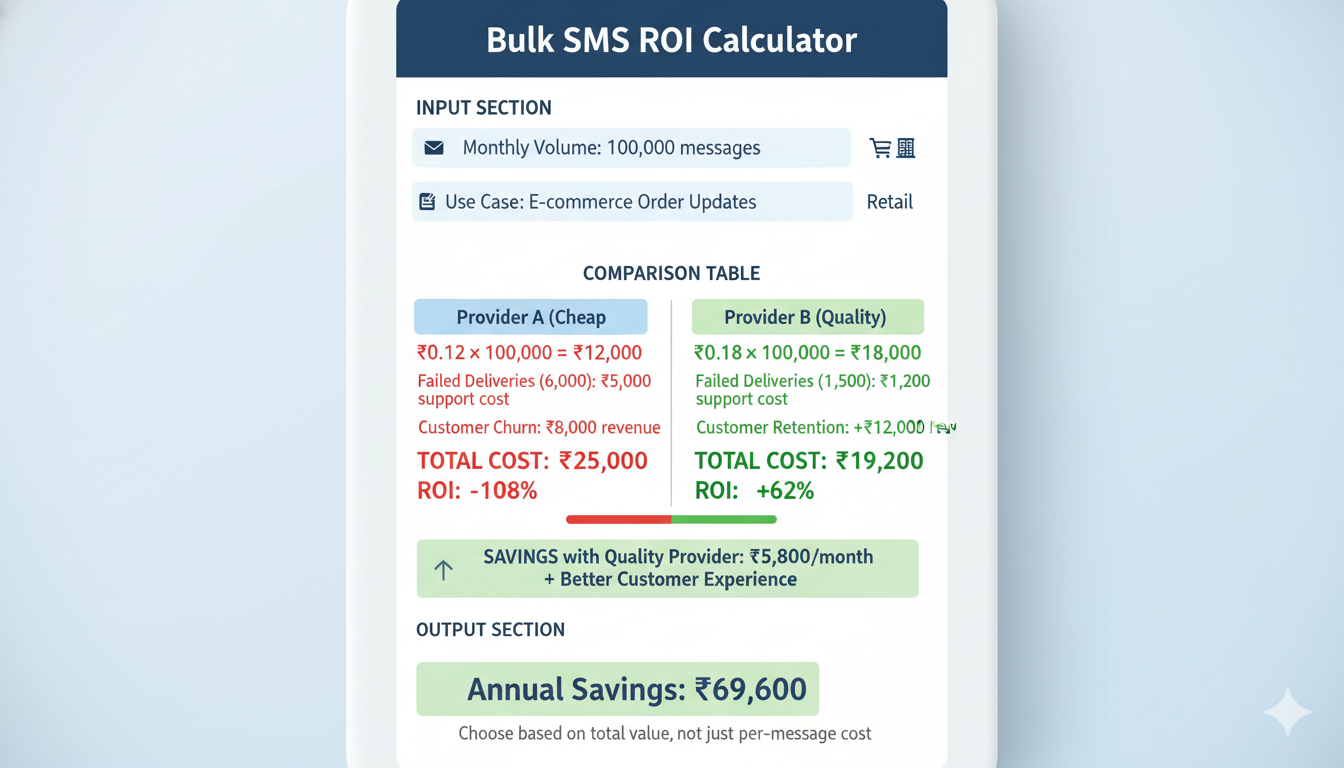
Volume tiers create the most obvious variation. Send 10,000 messages monthly, and you might pay ₹0.18 each. Commit to 500,000 monthly, and rates drop to ₹0.11. This volume-based pricing rewards scale but punishes businesses with fluctuating needs. Some bulk SMS service providers in India lock you into monthly minimums—you pay for 100,000 messages whether you send them or not.
Operator premium fees hide in many contracts. Messages to Airtel subscribers might cost ₹0.15, but Vodafone-Idea could charge ₹0.18 per message due to different carrier agreements. Unless your provider explicitly guarantees uniform pricing across all operators, you're vulnerable to these hidden surcharges that only appear in detailed billing statements.
DLT registration and template scrubbing add approximately ₹0.025 per message. Some providers include this in their base rate. Others list it as a separate line item. A third group charges it but doesn't clearly disclose it during sales discussions. When you're sending millions of messages, these fractions accumulate into thousands of rupees monthly.
Delivery retry fees represent the most deceptive cost structure. Your message fails to deliver on the first attempt. The system automatically retries through different routes. Each retry attempt gets billed separately. That ₹0.12 OTP suddenly costs ₹0.36 because of three retry attempts, and most dashboards don't clearly separate initial sends from retries.
International delivery to Indian numbers abroad multiplies costs dramatically. Your domestic rate of ₹0.15 becomes ₹2.50-6.00 per message depending on the destination country. For businesses with traveling customers or NRI clientele, these international charges can destroy budget projections if not accounted for upfront.
SMSGatewayHub.com provides transparent, all-inclusive pricing with no hidden fees. Our rate cards show exactly what you'll pay per message across all operators, including DLT charges and international pricing. No surprises, no fine print, no billing disputes three months after you start.
The Technical Truth About Delivery Speed
Every bulk SMS provider in India claims instant delivery. "Messages sent in under 5 seconds" appears in nearly every marketing deck. Yet actual performance varies wildly based on infrastructure decisions most businesses never think to question.
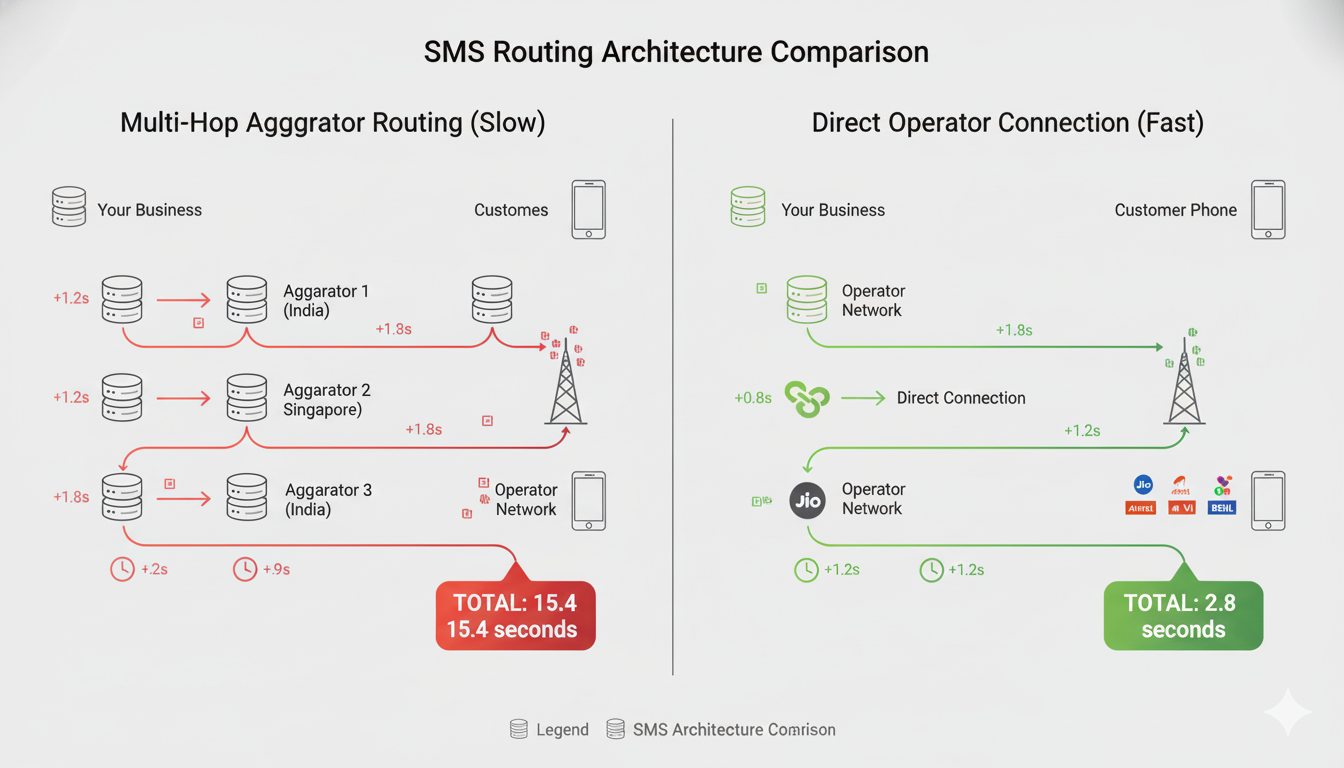
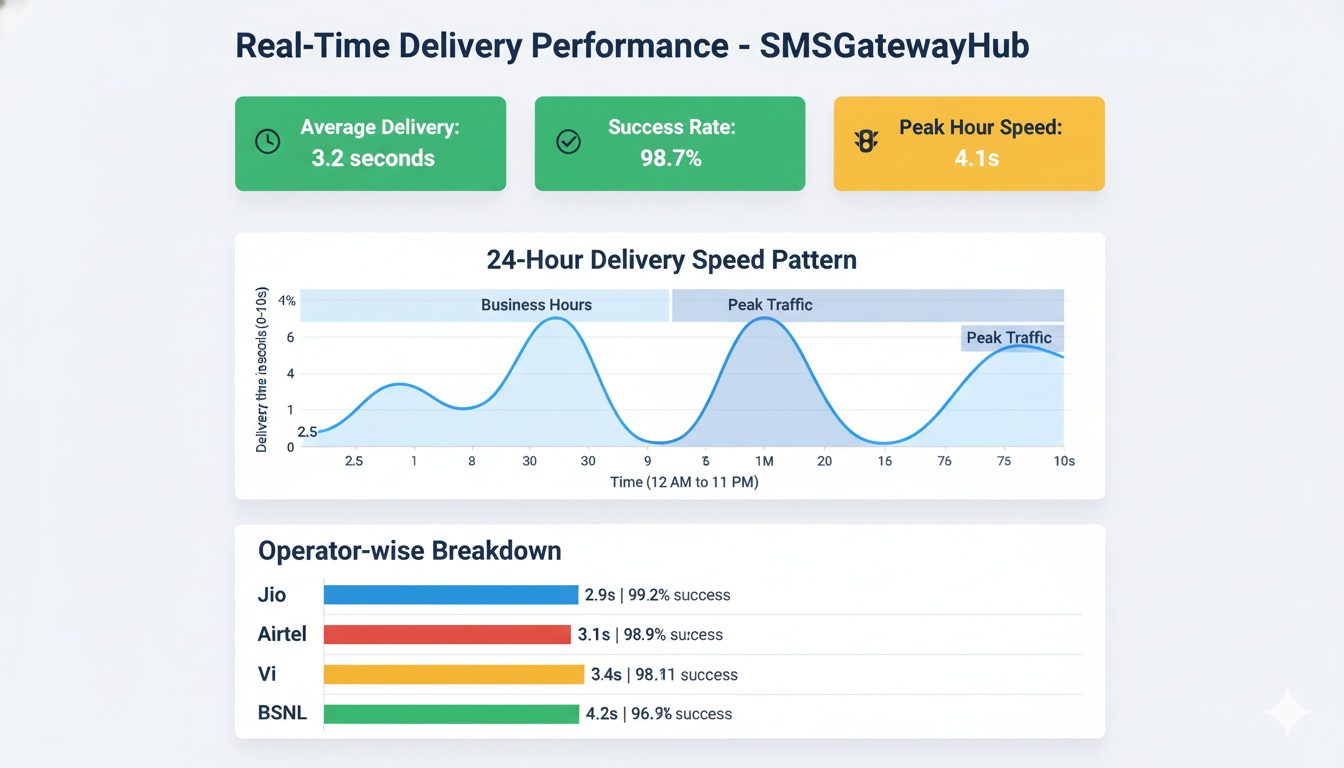
Direct operator connections versus aggregator routing makes the single biggest difference. Quality providers maintain dedicated links with Jio, Airtel, Vi, and BSNL. Your message travels one hop from their servers to the operator network to the recipient's phone. This architecture consistently achieves 2-4 second delivery times.
Cheaper providers route through multiple aggregators. Your message bounces from your provider to Aggregator A to Aggregator B to the operator network to the phone. Each hop adds 500-1000 milliseconds plus variable queue time during peak hours. Those "5 second" promises turn into 15-25 second reality when networks face evening traffic loads.
The difference matters enormously for time-sensitive messages. A promotional SMS announcing a 2-hour flash sale can tolerate 15-second delivery. An OTP code for payment authentication cannot. Users will retry, call support, or abandon transactions entirely when authentication codes don't arrive within 5-7 seconds of requesting them.
Geographic routing optimization separates good providers from great ones. India's telecom infrastructure varies significantly by region. Jio dominates in some areas. Airtel performs better in others. Vi has pockets of excellent coverage. BSNL reaches rural areas others can't touch.
Smart transactional bulk SMS service providers monitor real-time delivery performance across operators and regions. They automatically route messages through the fastest path for each specific recipient. A message to a Jio subscriber in Mumbai goes direct. Another to an Airtel user in rural Bihar might route differently to ensure reliable delivery. This intelligent routing costs more to implement but delivers measurably better results.
DLT Compliance: Beyond the Basics
TRAI's DLT mandate transformed the bulk SMS industry, eliminating spam but creating compliance complexity many businesses struggle with. Understanding these requirements helps you evaluate whether a transactional SMS service provider can actually manage the regulatory burden for you.
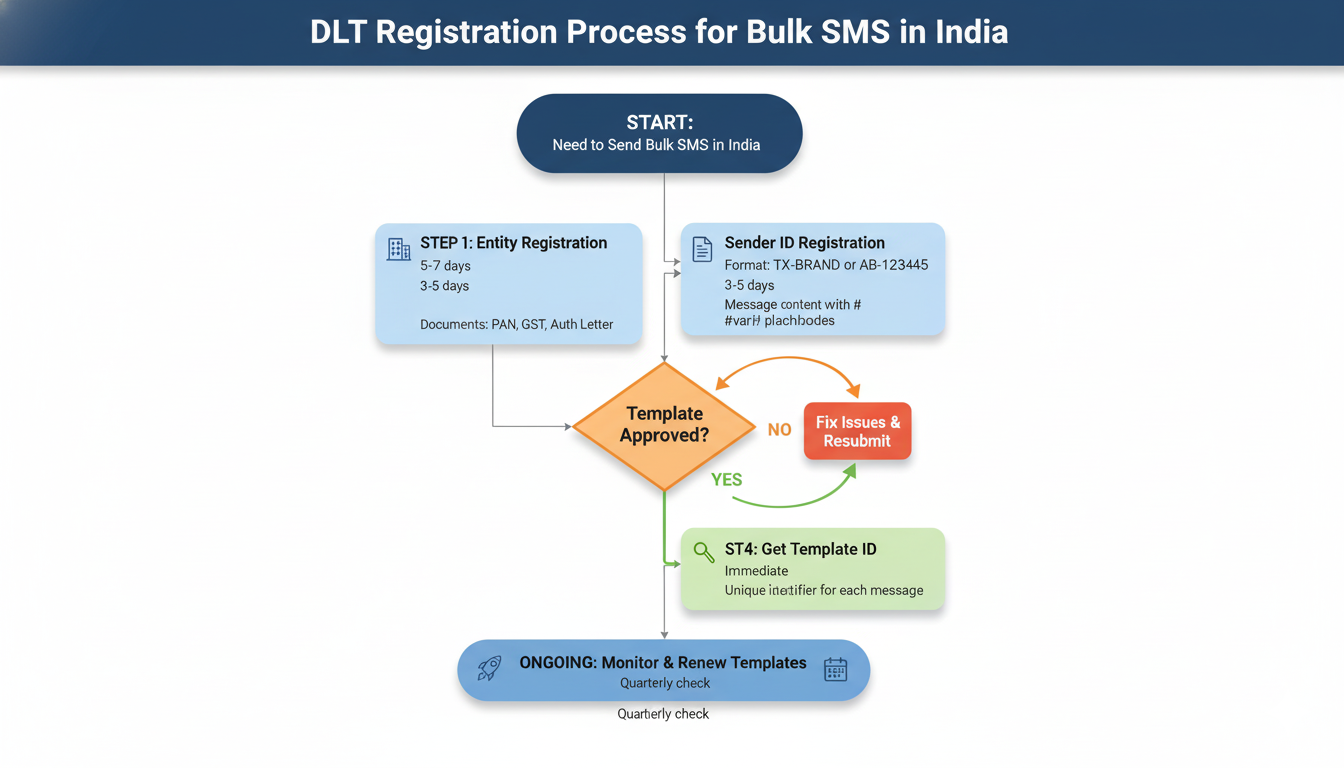
Entity registration requires business documentation—PAN, GST certificates, authorized signatory details. This one-time process typically takes 5-7 business days for approval. Most providers handle this registration through their platforms, though some still require manual submission to operator portals.
Sender ID registration determines how recipients see your business name. Promotional IDs follow the format AB-123456 where the first two characters indicate the operator and region. Transactional IDs allow your actual business name up to six characters. Getting these IDs approved takes 3-5 days, and you need separate IDs for promotional versus transactional messages.
Template approval represents the ongoing compliance challenge. Every message you send must match a pre-approved template character-by-character, including spaces and punctuation. Variable content uses {#var#} placeholders. Your approved template might read: "Your OTP for {#var#} is {#var#}. Valid for {#var#} minutes." You can't deviate from this structure without submitting a new template for approval.
Template rejections happen frequently. Operators reject templates for missing brand names, unclear variable purposes, promotional content in transactional templates, or formatting inconsistencies. Each rejection adds 3-5 days to your launch timeline while you fix issues and resubmit.
Template expiration tracking catches many businesses off guard. Templates don't last forever. They require periodic renewal, and the renewal schedule varies by operator. If a template expires and you continue sending messages using it, those messages get blocked. The best bulk SMS service provider in India maintains template databases that track expiration dates and alert you well before renewal deadlines.
The promotional SMS provider you choose should offer automated template management. Their platform validates your message content before submission, flags potential rejection reasons, handles the approval workflow, and maintains renewal calendars. Trying to manage DLT compliance manually while running your business is asking for campaign disruptions.
Don’t Miss These - DLT Registration in India - Complete Step by Step Guide
What Makes a Provider Actually Reliable
When businesses research the best bulk SMS service provider in India, they typically compare feature lists and pricing tables. These surface-level evaluations miss the operational factors that determine whether a provider becomes a trusted partner or a constant headache.
Infrastructure redundancy prevents single points of failure. Quality providers maintain multiple server locations across different geographic zones and cloud providers. If one data center experiences issues, traffic automatically fails over to backup infrastructure without service interruption. Ask potential providers about their disaster recovery architecture and what their actual uptime statistics look like over the past 12 months.
Carrier relationship quality determines how providers handle the inevitable complications. Operator networks experience outages, routing changes, and policy updates. When problems occur, does your provider have direct technical contacts at Jio, Airtel, Vi, and BSNL who can escalate and resolve issues? Or do they file tickets through standard channels and wait days for responses?
API architecture matters more as your messaging needs become sophisticated. RESTful APIs with comprehensive documentation enable quick integration. Webhook support for delivery status callbacks lets your application respond to successful or failed deliveries in real time. Rate limiting to prevent accidental message floods protects your sender reputation. SDKs in multiple programming languages accelerate development.
Monitoring and analytics capabilities determine whether you can optimize campaigns or just blindly send messages and hope for results. Real-time delivery tracking shows exactly when each message was sent, which operator handled it, and whether it delivered successfully. Operator-level analytics reveal that your Airtel delivery rates significantly lag behind Jio and Vi, prompting investigation. Geographic breakdowns show your messages to tier-3 cities experience higher failure rates than metros.
The OTP SMS service provider you select should offer separate analytics for authentication messages versus other transactional content. OTP delivery metrics require tighter tolerances—anything over 5-second delivery or below 98% success rates demands immediate attention.
Support responsiveness becomes critical during incidents. Messages not delivering during your flash sale at 9 PM on Saturday night can't wait until Monday morning office hours. The transactional SMS provider India businesses depend on must offer 24/7 technical support with actual engineering access, not just first-level help desk.
Start messaging today - Developer SMS API Free SMS Gateway Developer API
The Promotional vs Transactional vs OTP Decision Tree
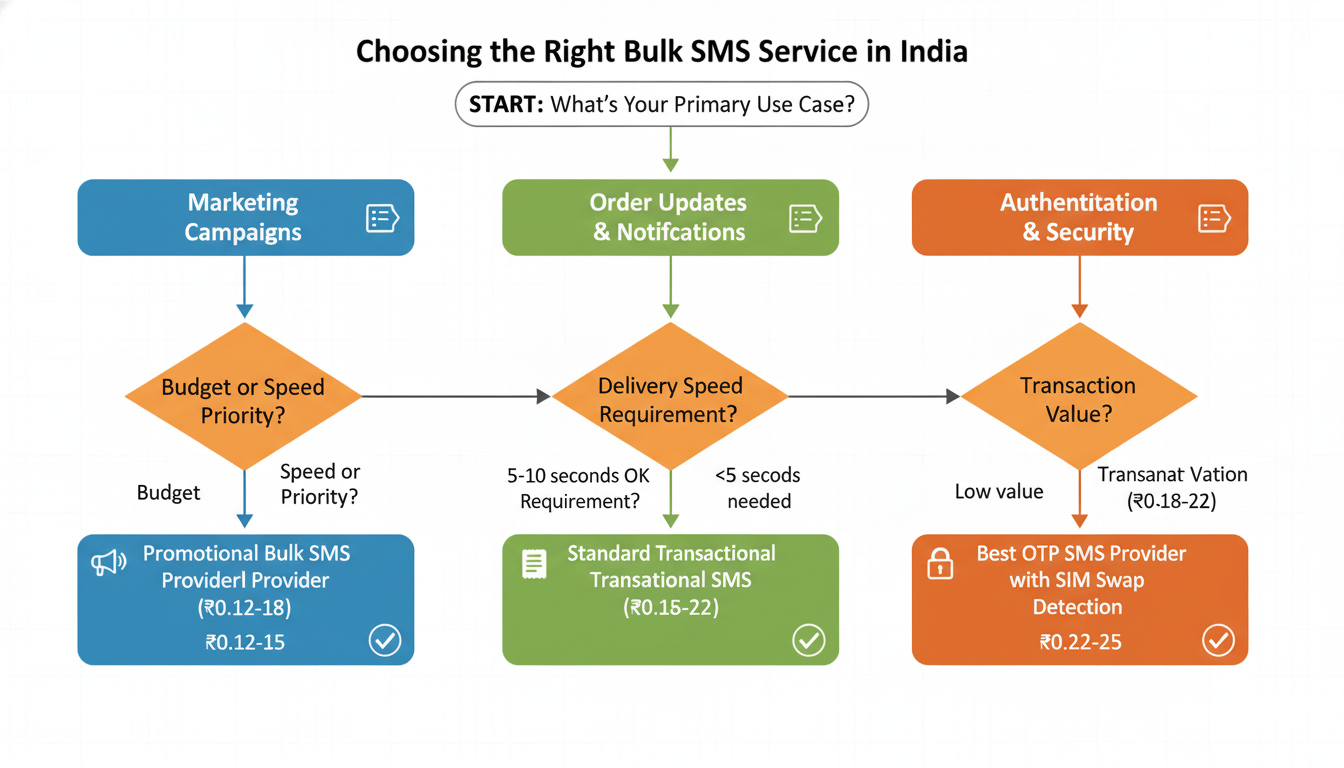
Many businesses start by asking "which bulk SMS provider in India should I use?" without first clarifying which type of messaging they need. This confusion leads to poor provider selection and performance disappointment.
Use a promotional bulk SMS service provider when your primary need involves marketing campaigns, sales announcements, event invitations, or discount notifications to large customer lists. You're willing to accept 9 AM-9 PM time restrictions and DND compliance requirements in exchange for lower per-message costs. Your delivery speed requirements are measured in seconds to minutes rather than milliseconds. Messages occasionally taking 15-20 seconds to deliver won't damage your business objectives.
Choose a transactional SMS service provider when you're sending order confirmations, shipping updates, appointment reminders, password reset links, or account notifications. You need 24/7 delivery capability without time restrictions. Your messages must bypass DND registers because customers actively expect this information. Delivery within 5-8 seconds matters significantly but microsecond precision isn't critical. You're willing to pay slightly more per message for faster routing and higher reliability.
Select an OTP SMS service provider when authentication codes, two-factor verification, payment authorization, or security-critical one-time passwords represent your primary use case. Sub-5-second delivery isn't just nice to have—it's mandatory for acceptable user experience. Even 98% delivery rates aren't good enough; you need 99%+ success. You require sophisticated rate limiting to prevent OTP bombing attacks. SIM swap detection capabilities help flag suspicious verification attempts.
SMSGatewayHub.com offers specialized routing for each message type through a unified platform. Send promotional campaigns through cost-optimized paths. Route transactional messages through faster channels. Deliver OTPs via premium express routes with sub-4-second guarantees. One API, one dashboard, automatic intelligent routing based on message classification.
Start messaging today -How to Choose Best SMS Gateway Provider India
Hidden Technical Factors That Kill Campaigns
Beyond pricing and features, technical implementation details determine whether your bulk SMS campaigns succeed or fail. These factors rarely appear in provider comparison charts yet make enormous practical difference.
Message concatenation handling affects costs when your content exceeds 160 characters. A 170-character message splits into two SMS units, doubling your cost. Different providers handle concatenation differently. Some charge per 160-character segment. Others charge per 153 characters to account for concatenation headers. A 480-character message might cost 3x or 4x your base rate depending on the provider's concatenation logic.
Unicode character support determines whether you can send messages in Hindi, Gujarati, Tamil, or other Indian languages. Unicode messages reduce the character limit to 70 per SMS unit instead of 160. Your bilingual campaign suddenly costs twice what you budgeted. Quality providers clearly document Unicode pricing and help you optimize message length to minimize extra charges.
Sender ID consistency across operators confuses many businesses. You register TX-BRAND as your transactional sender ID. Messages to Airtel and Jio subscribers display TX-BRAND correctly. Messages to Vi subscribers randomly show different sender IDs or get marked as "unknown." This happens because of incomplete sender ID registration across all operators. The best bulk SMS service provider in India ensures your sender IDs work consistently across Jio, Airtel, Vi, and BSNL before declaring them production-ready.
DLR (Delivery Receipt) reliability affects whether you can trust your success metrics. Some providers report 95% delivery based on operator acceptance—not actual handset delivery. The message reached the operator network, so the provider counts it as delivered, even if it never reached the recipient's phone. Real delivery confirmations require DLR integration with operator networks, which not all providers maintain consistently.
Rate limiting and throttling protect your campaigns from sudden spikes that trigger spam filters. Send 100,000 messages simultaneously, and operator networks might flag your sender ID as suspicious, blocking subsequent messages. Quality providers implement intelligent throttling that spreads message volume over time—fast enough to meet your business needs, slow enough to avoid triggering anti-spam measures.
Related Articles - Transactional SMS Solution: The Ultimate Guide for Businesses
Regional Delivery Patterns Nobody Discusses
India's vast geographic and infrastructure diversity creates delivery performance variations most bulk SMS rate in India discussions ignore. Understanding these patterns helps set realistic expectations and optimize provider selection.
Metro cities—Mumbai, Delhi, Bangalore, Hyderabad—achieve the highest delivery rates, typically 98-99%, with the fastest speeds of 2-4 seconds. Dense operator infrastructure, strong network coverage, and high-quality towers ensure reliable message delivery. If your customer base concentrates in these metros, almost any decent provider will perform adequately.
Tier-2 cities like Pune, Jaipur, Ahmedabad, and Kochi show slightly lower performance—95-97% delivery rates with 4-6 second speeds. Network congestion during evening hours can push delivery times to 8-10 seconds. Provider quality starts mattering more at this level. Those with direct operator connections maintain better performance than aggregator-based routing.
Tier-3 towns and rural areas present the biggest challenges. Delivery rates can drop to 88-92% with variable timing ranging from 6 to 30+ seconds depending on network conditions. BSNL often provides the only reliable coverage in some rural pockets, making your provider's BSNL relationship critical if you serve these markets.
Operator performance varies by region in ways that surprise businesses. Jio might dominate in Gujarat but face congestion in parts of Bihar. Airtel performs exceptionally in Karnataka but shows weaker results in some northeastern states. The transactional SMS API you integrate should offer operator selection or automatic routing based on recipient location and real-time performance data.
Seasonal patterns affect delivery across all regions. Festival periods—Diwali, Dussehra, Holi—see massive SMS volume spikes that congest networks. January and July experience higher delivery failures due to new subscriber activations and SIM swaps. December shows lower failures as business messaging volume drops during holidays.
Check latest price list - Maximize ROI with our award-winning bulk SMS Sending platform
The Security Dimension Most Providers Ignore
As businesses send more OTPs, payment verifications, and sensitive notifications, security becomes as important as delivery speed. Yet most bulk SMS provider in India conversations focus entirely on pricing and features while overlooking critical security considerations.
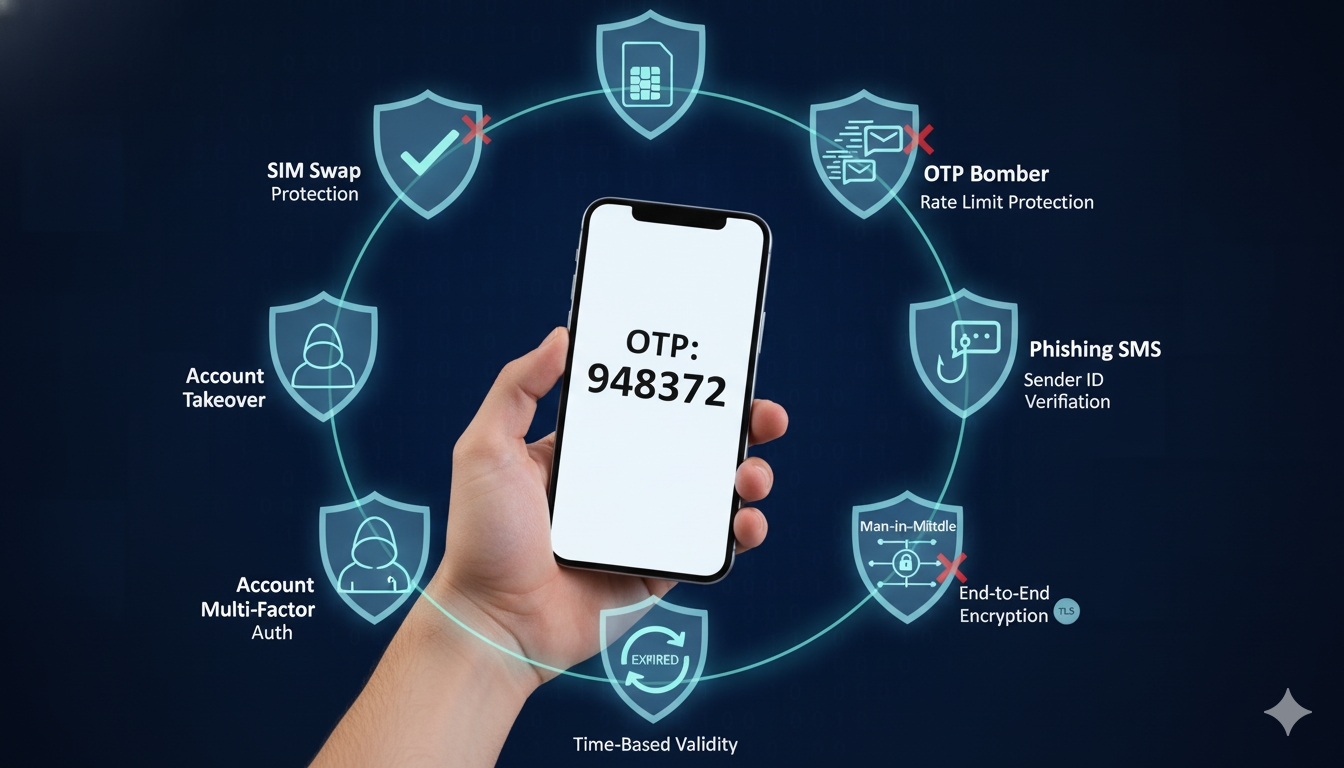
Message encryption in transit protects your OTP codes and sensitive information from interception. TLS encryption between your servers and the SMS gateway prevents eavesdropping on API calls. Some providers also encrypt message content during operator transmission, though this is rarer and costs more.
Sender ID spoofing prevention stops fraudsters from sending fake messages appearing to come from your business. Without proper controls, someone could send "Your account has been locked, call this number immediately" using your brand name, directing victims to scam call centers. Quality providers implement sender ID verification and anti-spoofing measures that prevent unauthorized use of your registered IDs.
OTP bombing protection at the infrastructure level blocks attacks where someone floods a phone number with verification code requests. The attack serves multiple purposes—harassment, distraction while attempting actual fraud elsewhere, or resource exhaustion against your platform. Your OTP SMS service provider in India should enforce rate limits preventing any single number from receiving more than 3-5 OTPs within 5-10 minutes.
SIM swap detection flags when a recipient's number recently underwent a SIM change. Banks and fintech companies use this data to add extra verification steps before processing high-value transactions. If your business handles financial transfers, the best OTP SMS service provider in India offers SIM swap detection through carrier integrations.
Delivery route security matters for highly sensitive messages. Some providers route messages through multiple countries or third-party networks where interception becomes easier. Direct operator connections within India provide better security by minimizing international transit and third-party touchpoints.
Two-factor authentication for provider platform access ensures only authorized team members can send messages or modify templates. API key rotation policies, IP whitelisting, and webhook signature verification prevent unauthorized access to your messaging infrastructure.
Read Related - OTP Service in India - What is OTP and How Does It Work?
Integration Complexity: The Hidden Time Cost
Technical integration effort rarely factors into provider selection decisions, yet it determines how quickly you can launch and how much developer time you'll burn. Integration complexity varies wildly across bulk SMS service providers in India.
API documentation quality ranges from comprehensive examples in multiple languages to vague endpoint descriptions that require experimentation to understand. The best providers offer complete code samples in Python, PHP, Node.js, Java, and Ruby, covering common use cases like sending single messages, bulk batches, retrieving delivery reports, and handling errors.
Webhook implementation for delivery callbacks requires your provider to POST delivery status updates to your servers. This seems simple until you discover their webhooks don't include signature verification, making them vulnerable to spoofing. Or they don't retry failed webhook deliveries, causing you to miss delivery confirmations when your server is briefly unavailable.
SDK availability accelerates integration significantly. Official SDKs handle API authentication, retry logic, error handling, and data formatting automatically. Without SDKs, your developers spend days building these mechanisms from scratch, testing edge cases, and debugging subtle issues.
Dashboard-based sending works for occasional manual campaigns but doesn't scale to automated messaging triggered by application events. If you need to send order confirmations, shipping updates, or OTPs based on user actions, you must integrate the transactional SMS API with your application code, CRM, or e-commerce platform.
Webhook signature verification validates that delivery status callbacks genuinely come from your provider rather than attackers spoofing the callback endpoint. Quality providers include HMAC signatures with webhook payloads, along with clear documentation on signature calculation and verification.
Testing environments separate from production prevent costly mistakes. Send test messages to your own numbers without consuming credits or risking customer-facing issues. Validate template formatting, test error handling, and verify delivery callbacks work correctly before going live.
You May Also Like - Best Bulk SMS & WhatsApp Messaging Service Provider 2026
Making the Right Provider Decision
Selecting among the many bulk SMS service providers in India requires evaluating multiple factors simultaneously rather than optimizing for any single dimension like price or features.
Start with clear use case definition. Document whether you need promotional campaigns, transactional notifications, OTP delivery, or a combination. Note your expected monthly volume, required delivery speeds, target geographic regions, and budget constraints. This clarity prevents getting distracted by features you don't need or missing capabilities you do.
Request trials or pilot programs before committing to volume contracts. Send several thousand messages through your top three provider candidates. Measure actual delivery speeds during different times of day. Track success rates across different operators and regions. Evaluate dashboard usability, API integration effort, and support responsiveness when you deliberately create edge case scenarios.
Review contract terms carefully beyond just per-message pricing. What are minimum monthly commitments? How do they handle unused message credits—rollover or forfeit? What are cancellation terms if you're unsatisfied? Are there setup fees, monthly platform charges, or hidden surcharges?
Check regulatory compliance documentation. How does the provider handle DLT registration? Do they manage template approvals through their platform or require manual operator portal access? What happens when templates need renewal? How quickly can you get new templates approved?
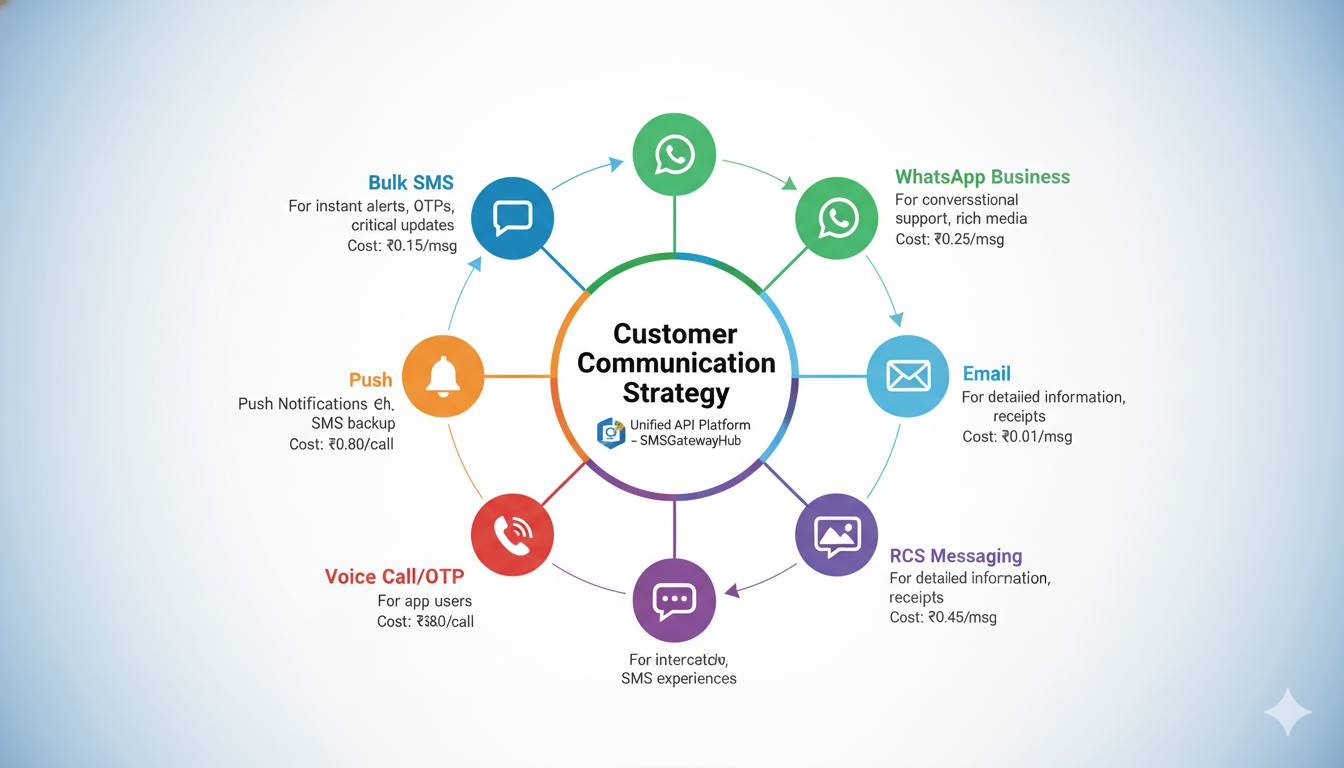
Evaluate the provider's roadmap for emerging technologies. RCS messaging is coming. WhatsApp Business APIs are growing. Voice OTP serves as backup when SMS fails. Will your provider offer these channels through unified APIs, or will you need to integrate multiple vendors as requirements evolve?
SMSGatewayHub.com welcomes pilot programs where businesses can test our delivery speeds, success rates, and platform capabilities with trial credits before deciding. We believe the best way to demonstrate value is letting you experience the difference directly rather than relying on marketing claims.
Complete Guide to Choosing - Bulk SMS Service in India Choosing the Right Provider
The Future: Beyond Traditional SMS
While bulk SMS remains dominant in India's business communication landscape, understanding emerging alternatives helps future-proof your messaging strategy and provider selection.
RCS (Rich Communication Services) represents SMS evolution, supporting images, buttons, carousels, and read receipts within messages. Early adoption remains limited—only 8.3% of Indian businesses tested RCS in 2025—but projections show 45% adoption by year-end. RCS costs 2-3x more than SMS but offers engagement rates approaching app-level experiences. Forward-thinking promotional SMS providers are adding RCS support now, allowing brands to gradually migrate higher-value campaigns.
WhatsApp Business API has captured significant message volume for brands with established customer relationships. Messages deliver through data connections rather than SMS networks, often faster and more reliably. End-to-end encryption provides better security. Costs per message are competitive with premium SMS routes. The limitation? Customers must initiate contact with your business first, making WhatsApp unsuitable for first-time customer acquisition but excellent for ongoing communication.
Voice OTP serves as fallback when SMS delivery fails in poor network areas. An automated call speaks the verification code instead of texting it. Voice OTP works on every phone type—smartphones, feature phones, even landlines—ensuring universal reachability. Quality OTP SMS service providers offer automatic SMS-to-voice failover, trying SMS first and switching to voice if delivery doesn't confirm within 10 seconds.
Push notifications through mobile apps reach customers instantly when implemented correctly, with zero per-message cost after development. The challenge? Customers must install your app, grant notification permissions, and keep the app installed. This limits push notifications to brands with strong customer loyalty and high engagement.
Email remains valuable for detailed information that doesn't fit SMS character limits, though open rates (20-30%) lag far behind SMS (98%). Smart communication strategies use SMS for time-sensitive alerts with email for comprehensive details—"Your order has shipped [SMS]" followed by tracking details, delivery instructions, and return policies via email.
The most effective approach combines channels intelligently. Send transactional SMS for critical real-time notifications. Follow with email for detailed information. Use WhatsApp for conversational support. Reserve voice OTP for SMS delivery failures. The best bulk SMS provider in India offers multi-channel capabilities through unified APIs and dashboards rather than forcing you to manage separate vendors for each communication type.
Taking Action
The Indian bulk SMS market processes 186.2 billion messages annually across ₹4,290 crores in value. Every business sends messages. The question isn't whether to use SMS—it's whether you're using it effectively through the right provider with appropriate message types and realistic performance expectations.
SMSGatewayHub.com delivers what most providers only promise: sub-4-second delivery speeds through direct operator connections, transparent all-inclusive pricing with no hidden fees, automatic DLT template management that prevents compliance headaches, 24/7 technical support from actual engineers rather than help desk scripts, and real-time analytics across operators and regions so you can optimize based on data.
Whether you need promotional campaigns to drive sales, transactional notifications to improve customer experience, or OTP delivery for secure authentication, we provide specialized routing optimized for each message type through one unified platform.
Start with 10,000 free message credits to test our delivery speeds and success rates in your actual business context. Experience the difference direct operator connections and infrastructure quality make before committing to volume contracts. Visit SMSGatewayHub.com to begin your trial and discover why thousands of Indian businesses trust us for their critical messaging needs.
ABOUT THE AUTHOR
This guide is written by SMSgatewayHub - India's trusted bulk SMS service provider since Oct 2010.
We send 1000 million+ Bulk daily to protect Indian citizens and businesses.
Need help with DLT registration? 📞 Call: +91-9907922122 📧 Email: support@smsgatewayhub.com
To Find Related Articles-