How to Boost Valentine's Day Sales with Bulk SMS, WhatsApp & RCS Marketing Campaigns
Valentine's Day generates over ₹15,000 crores in sales across India annually, making it one of the most lucrative occasions for businesses. Yet many companies still rely on a single marketing channel, missing out on the compounding effect of multi-channel campaigns that can increase conversion rates by up to 287%.
The winning formula for Valentine's Day 2026 combines three powerful messaging channels: Bulk SMS for immediate reach, WhatsApp Business for rich engagement, and RCS (Rich Communication Services) for premium interactive experiences. When orchestrated correctly, this multi-channel approach doesn't just boost sales—it transforms casual browsers into loyal customers.
This comprehensive guide reveals exactly how to leverage all three channels to maximize your Valentine's Day revenue, with proven strategies, real campaign workflows, and implementation steps that work for businesses of any size.
👉 Get Free Demo | 👉 Talk to Bulk SMS Expert | 👉 Start Sending SMS Now
Contact SMSGatewayHub:
📞 Call: +91-9907922122
📧 Email: support@smsgatewayhub.com
🌐 Visit: www.smsgatewayhub.com
Understanding the Three-Channel Advantage
Before diving into tactics, let's understand why combining Bulk SMS, WhatsApp, and RCS creates exponential results rather than just additive benefits.
Bulk SMS serves as your reliability layer. With 98% open rates and compatibility with every mobile phone in India—from basic feature phones to the latest smartphones—SMS ensures your message reaches everyone. It's perfect for time-sensitive announcements, flash sales, and last-minute reminders when you need guaranteed delivery within minutes.
WhatsApp Business acts as your engagement layer. With over 487 million users in India and average response rates of 40-60%, WhatsApp enables two-way conversations, rich media sharing, and catalog browsing. It's ideal for personalized recommendations, answering questions, and nurturing customers through longer decision journeys.
RCS Messaging provides your premium layer. As the next evolution of SMS, RCS delivers app-like experiences directly in the default messaging app. With verified sender badges, carousel images, action buttons, and real-time analytics, RCS creates immersive brand experiences that drive 35% higher engagement than traditional SMS.
The strategic advantage emerges when you use each channel for what it does best, creating a seamless customer journey that meets people where they are with the right message at the right time.
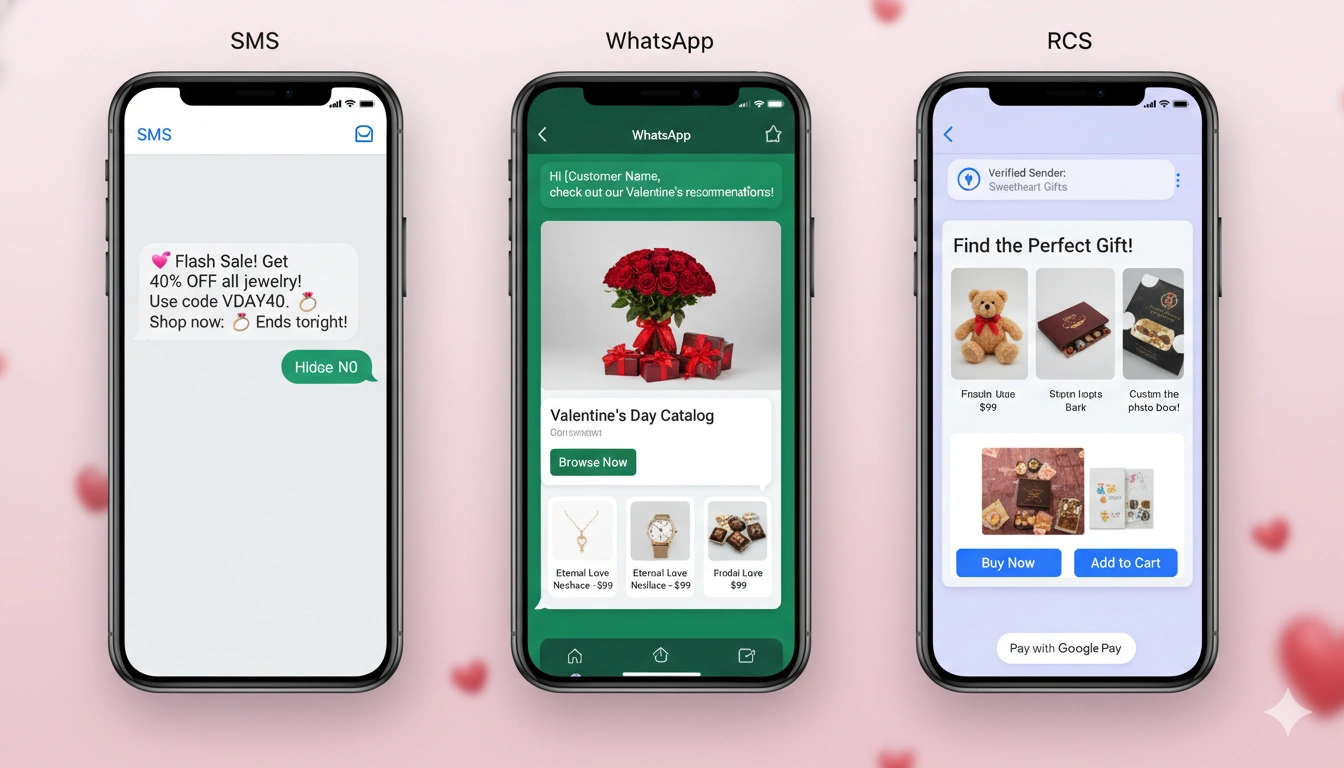
Strategic Timeline: Multi-Channel Valentine's Day Campaign
Success in Valentine's Day marketing comes from strategic timing across all three channels. Here's your week-by-week campaign framework:
Three Weeks Before (January 25-31): Launch your awareness phase exclusively via WhatsApp Business. Send personalized catalog messages showcasing your Valentine's collection to existing customers. The rich media format—images, videos, and product catalogs—helps customers visualize their purchases early. This soft launch builds anticipation without overwhelming your audience.
Two Weeks Before (February 1-7): Activate your Bulk SMS channel for broad reach. Send concise, compelling offers to your entire database announcing early-bird discounts. Follow up with WhatsApp messages to high-value customers offering VIP previews or exclusive deals. This dual-channel approach captures both mass market and premium segments simultaneously.
Valentine's Week (February 8-13): Intensify across all three channels with coordinated daily campaigns. Use Bulk SMS for daily flash sales and time-sensitive offers. Deploy WhatsApp for personalized recommendations based on browsing history. Launch RCS campaigns for your premium products, utilizing interactive carousels and one-tap purchase buttons.
Valentine's Day (February 14): Execute your last-minute conversion blitz. Send SMS reminders at 9 AM for "Order now for same-day delivery." Use WhatsApp chatbots to handle surging customer inquiries instantly. Deploy RCS for express shipping offers with real-time order tracking.
Post-Valentine's (February 15-16): Transition to retention mode. Send thank-you messages via WhatsApp with photos of delivered orders (with permission). Use SMS for customer satisfaction surveys. Launch RCS campaigns promoting your next occasion (Women's Day, Holi) to maintain momentum.
DLT Registration: Step-by-Step for All Operators
Airtel DLT Registration Guide
BSNL DLT Registration Guide
Jio DLT Registration Guide
VIL DLT Registration Process Guide
SmartPing DLT Registration Process Guide
Bulk SMS Campaigns That Convert
Bulk SMS remains the backbone of Valentine's Day marketing due to its unmatched reach and immediacy. Here's how to maximize its impact:
Segment Ruthlessly: Don't send identical messages to your entire database. Create segments based on purchase history, demographics, and engagement levels. First-time buyers receive introductory offers; loyal customers get VIP discounts; inactive customers receive win-back campaigns. Platforms like SMSGatewayHub enable sophisticated segmentation through their dashboard.
Master the 160-Character Formula: Your SMS must deliver complete value within 160 characters. Follow this structure: Hook (emoji + benefit) + Offer (specific discount/deal) + Urgency (deadline) + Action (short link/code). Example: "💝 Valentine's Special! 30% OFF all gifts. Today only! Use LOVE30 → bit.ly/v2026"
Timing Precision Matters: Send SMS during high-engagement windows: 10-11 AM (morning tea break), 2-3 PM (post-lunch), and 7-8 PM (evening leisure). Avoid sending before 9 AM or after 9 PM. For Valentine's Day itself, the 8-10 AM window captures last-minute shoppers in panic mode.
Implement Progressive Disclosure: Don't reveal everything in one SMS. Send a teaser ("Valentine's surprise coming tomorrow at 6 PM!") followed by the actual offer. This two-SMS sequence builds anticipation and increases engagement rates by 45% compared to standalone messages.
Use Dynamic Short URLs: Every SMS must include a trackable short link leading to mobile-optimized landing pages. Tools like Bitly or custom URL shorteners help you track click-through rates by segment, time, and campaign—essential data for optimization.
Leverage Transactional SMS Strategically: Order confirmations, shipping updates, and delivery notifications reach customers even on DND registry. Subtly include cross-sell messages: "Your Valentine's gift will arrive tomorrow. Complete the surprise with our chocolate collection: [link]"
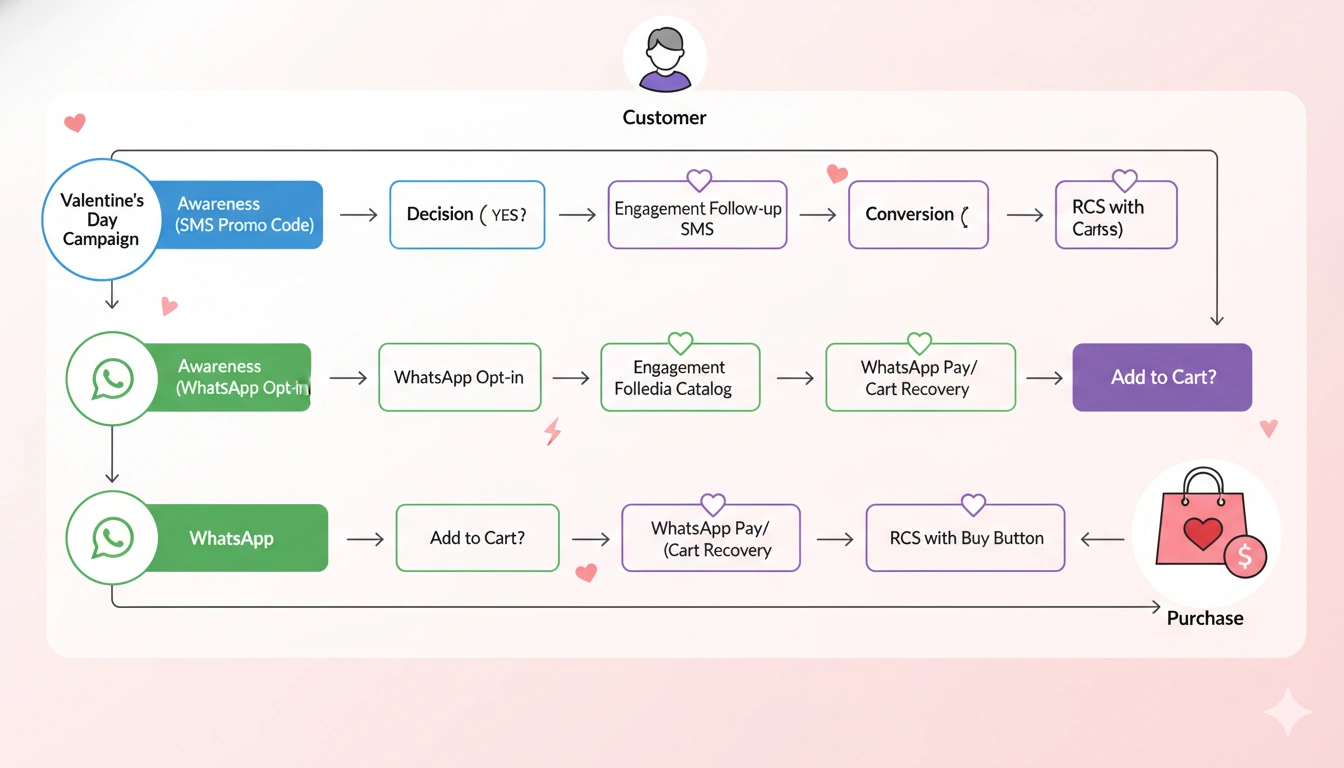
WhatsApp Business Marketing Excellence
WhatsApp transforms Valentine's Day marketing from broadcasting to conversing. Here's your implementation playbook:
Build Your WhatsApp Business Profile: Before campaigns begin, optimize your business profile with Valentine's-themed display picture, compelling business description, catalog of top gift items, and business hours. Enable quick replies for common questions like "Do you have same-day delivery?" or "What's your return policy?"
Create Interactive Product Catalogs: WhatsApp Business catalogs let customers browse your entire Valentine's collection without leaving the chat. Organize products by category (For Him, For Her, For Couples), price range, and occasion (Rose Day, Promise Day, Valentine's Day). Update catalog daily with stock availability to prevent disappointment.
Implement WhatsApp Chatbots: Automation handles 80% of routine inquiries, freeing your team for complex customer service. Set up chatbots to answer FAQs, provide product recommendations based on budget, share size guides, check order status, and book appointments for in-store shopping consultations.
Use Broadcast Lists Smartly: Unlike WhatsApp groups, broadcast lists send messages individually while appearing personal. Create segmented broadcast lists (by location, purchase history, or product interest) and send personalized recommendations. Limit broadcasts to 2-3 times per week to avoid annoying customers.
Enable Click-to-WhatsApp Ads: Run Facebook/Instagram ads that open WhatsApp conversations directly. These ads generate 3x higher conversion rates than standard ads because they reduce friction—customers can ask questions and purchase without visiting your website.
Launch WhatsApp-Exclusive Offers: Create special deals available only via WhatsApp to incentivize customers to message you. "Show this WhatsApp message in-store for additional 10% discount" drives both online engagement and offline foot traffic.
Leverage Status Updates: WhatsApp Status (similar to Instagram Stories) reaches all your contacts simultaneously. Post daily Valentine's countdown, behind-the-scenes content, customer testimonials, flash sale announcements, and limited stock alerts. Status views indicate interest levels for retargeting.
Collect Customer Reviews via WhatsApp: Post-purchase, send a WhatsApp message requesting photo reviews. Offer incentives ("Share your Valentine's surprise photo and get ₹200 voucher for next purchase"). User-generated content becomes powerful social proof for future campaigns.
Read Article - Top Bulk SMS Service Provider in India
RCS Messaging: The Premium Channel
RCS (Rich Communication Services) represents the future of business messaging, offering app-like experiences in the default messaging app. For Valentine's Day 2026, RCS provides competitive advantages:
Verified Sender Badge: RCS messages display your business logo and verified checkmark, eliminating customer concerns about spam or phishing. This trust factor increases engagement rates by 40% compared to sender IDs in regular SMS.
Rich Media Experiences: Unlike SMS's text-only limitation, RCS supports high-resolution images, video messages, GIFs, and carousels. Showcase your Valentine's products in stunning detail—rotating 360° views of jewelry, video demonstrations of gift hampers, or before-after testimonials.
Interactive Action Buttons: Embed buttons directly in messages for instant actions: "Shop Now," "Book Appointment," "Call Us," "View Catalog," or "Track Order." Customers complete actions without leaving the message, reducing friction and increasing conversion by 35%.
Carousel Cards for Product Discovery: Present multiple products in swipeable carousel format. Each card contains an image, description, price, and action button. Perfect for "Valentine's Day Gift Ideas" campaigns where customers browse 5-10 options and tap to purchase their choice.
Real-Time Delivery and Read Receipts: Unlike SMS where you guess if messages were received, RCS provides WhatsApp-like delivery and read receipts. This data helps you time follow-up messages perfectly—send a reminder only if the message was delivered but not opened.
Location-Based Messaging: RCS can include interactive maps with your store locations, enabling customers to get directions with one tap. Crucial for driving foot traffic during Valentine's Week store events or experience centers.
Suggested Replies: Pre-populate response options for customers ("Yes, book my table," "Show me more options," "Remind me tomorrow"). This reduces customer effort and increases response rates by 60%, especially for appointment bookings or event RSVPs.
RCS Campaign Ideas for Valentine's Day:
- Interactive product quizzes ("Answer 3 questions, get personalized gift recommendations")
- Virtual try-on for jewelry/accessories with image uploads
- Appointment booking with calendar integration
- Gift customization workflows (select design → add message → confirm)
- Video greeting cards from business owners to customers
Platforms like SMSGatewayHub now offer RCS messaging capabilities alongside traditional SMS and WhatsApp integration, enabling you to manage all three channels from a single dashboard.
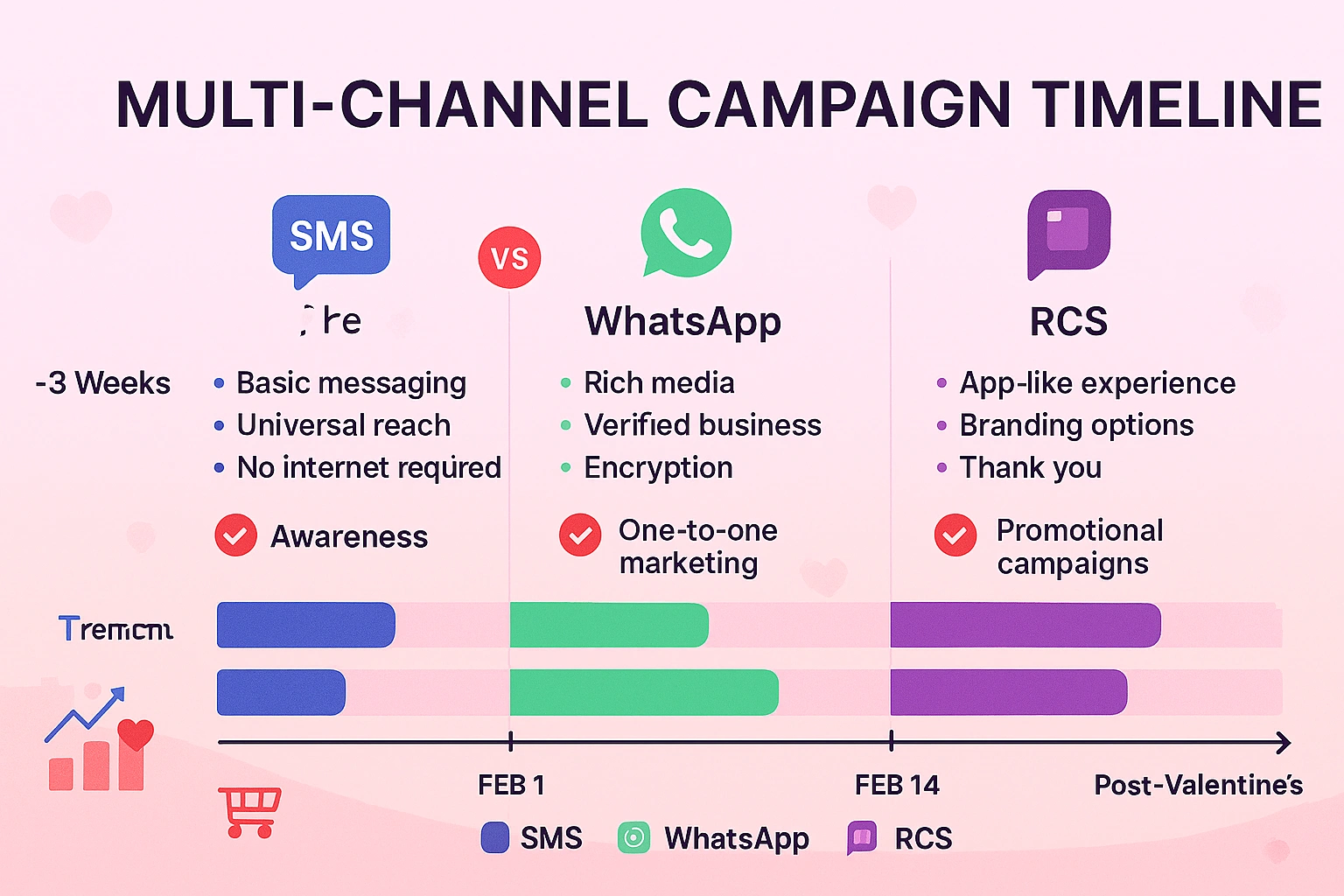
Creating Your Multi-Channel Campaign Workflow
The real power emerges when you orchestrate all three channels into cohesive customer journeys. Here are proven workflows:
Workflow 1: New Customer Acquisition
Day 1: Bulk SMS → "Valentine's Collection launched! 20% OFF for new customers: [link]"
Day 2: If clicked but didn't purchase → WhatsApp follow-up with personalized product recommendations
Day 4: If still no purchase → RCS carousel showcasing bestsellers with "Limited stock" urgency
Day 6: If no purchase → Final SMS with higher discount (30% OFF) for first purchase
Workflow 2: Cart Abandonment Recovery
Immediate: WhatsApp message → "You left [product name] in your cart! Complete order now?"
30 minutes: If no response → Bulk SMS with additional incentive → "Extra 10% OFF if you order in next 2 hours"
2 hours: If clicked SMS but didn't purchase → RCS message with product images, customer reviews, and one-tap checkout
24 hours: Final attempt via WhatsApp → Personal message from customer service offering assistance
Workflow 3: VIP Customer Engagement
Week 1: RCS exclusive preview → "You're invited! See our Valentine's Collection before anyone else" (carousel) Week 2: WhatsApp personal shopping → "Hi [Name], based on last year's purchase, we curated these options for you"
Week 3: SMS VIP flash sale → "Exclusive 24-hour early access to Valentine's sale for our VIP customers" Day before Valentine's: WhatsApp delivery confirmation → "Your order will arrive by 10 AM tomorrow"
Post-Valentine's: RCS thank you → Video message from founder + loyalty points
Workflow 4: Last-Minute Shoppers (Feb 13-14)
Feb 13, 8 PM: Bulk SMS → "24 hours left! Same-day delivery available till tomorrow 2 PM"
Feb 14, 8 AM: WhatsApp → "Valentine's Day is here! Express delivery in 4 hours available. Order now!"
Feb 14, 11 AM: RCS → Interactive catalog with "Express Delivery" tagged products + instant checkout
Feb 14, 3 PM: Final SMS → "Last chance! Digital gift cards delivered instantly: [link]"
Read More Price
Bulk SMS Transactional SMS Pricing
Bulk SMS Promotional SMS Pricing
Bulk SMS OTP SMS Pricing
Measurement and Optimization Strategy
Multi-channel campaigns require sophisticated tracking to identify what's working and what needs adjustment:
Essential Metrics by Channel:
For Bulk SMS: Track delivery rate (target: 98%+), click-through rate (target: 15-20%), conversion rate (target: 10-15%), opt-out rate (maintain below 2%), and cost per conversion.
For WhatsApp: Monitor message delivery rate, response rate (target: 40-60%), conversation completion rate, average response time, and customer satisfaction scores from post-chat surveys.
For RCS: Measure delivery rate, read rate (target: 80%+), button click rate (target: 25-35%), carousel interaction rate, and time-to-conversion from message delivery.
Cross-Channel Attribution: Use unique promo codes per channel (SMS: LOVE30, WhatsApp: WHAT30, RCS: RCS30) to track which channel drives actual purchases. Implement UTM parameters in all URLs to monitor traffic sources in Google Analytics.
A/B Testing Framework: Test one variable at a time across channels. For SMS, test send times (10 AM vs 7 PM). For WhatsApp, test message length (short vs detailed). For RCS, test carousel vs single-image formats. Run tests on 20% of audience before rolling out winners to remaining 80%.
Customer Journey Mapping: Use CRM integration to visualize how customers move between channels before purchasing. Identify common patterns: Do customers who receive SMS first and then WhatsApp convert better? Does RCS work better as first touch or follow-up? Adjust workflows based on data.
Real-Time Optimization: Don't wait until campaign ends to analyze. Monitor performance hourly during peak Valentine's Week. If SMS campaign shows low CTR by noon, adjust messaging or offer and resend to unopened segment in evening. If WhatsApp chatbot gets stuck on specific questions, add those FAQs immediately.
Advanced Strategies for Maximum Impact
Strategy 1: Channel-Specific Personalization Use each channel's strengths for personalization. SMS uses first names and purchase history ("Hi Priya, your favorite jewelry brand has Valentine's sale!"). WhatsApp accesses richer data for detailed recommendations. RCS enables behavioral personalization based on browsing patterns with dynamic product carousels.
Strategy 2: Progressive Profiling Each channel interaction collects customer data. SMS tells you who clicked. WhatsApp reveals product preferences through conversation. RCS tracks carousel interactions showing exact products they viewed. Feed this data back into segmentation for increasingly personalized future campaigns.
Strategy 3: Omnichannel Retargeting Create custom audiences from each channel's engagement data. Export SMS clickers to run Facebook ads. Target WhatsApp conversers with Google Display ads. Retarget RCS carousel viewers with Instagram Stories. This multi-touchpoint approach increases brand recall by 70%.
Strategy 4: Channel Preference Learning Track which customers prefer which channels. Some respond better to SMS (quick deciders), others need WhatsApp conversation (research-oriented), while premium shoppers engage with RCS (experience seekers). Over time, prioritize their preferred channel while maintaining presence on others.
Strategy 5: Urgency Escalation Use channel progression to build urgency. Day 1: WhatsApp soft suggestion. Day 3: SMS stronger call-to-action. Day 5: RCS with countdown timer in carousel. Day 7: SMS final warning. This graduated approach feels natural rather than pushy.
.webp)
Compliance and Best Practices
Multi-channel marketing must respect regulations and customer preferences:
TRAI Compliance for SMS: Never send promotional SMS to DND (Do Not Disturb) registered numbers. Maintain proper consent records. Include opt-out instructions in messages. Use registered sender IDs. Partner with TRAI-compliant platforms like SMSGatewayHub to ensure adherence.
WhatsApp Business Policies: Only message customers who've opted in. Respect the 24-hour messaging window (after customer initiates contact). Don't spam with excessive broadcasts. Provide easy opt-out options. Never share customer conversations publicly.
RCS Message Guidelines: Clearly identify your business with verified sender information. Don't send misleading messages or fake urgency. Respect user privacy—don't collect data unnecessarily. Provide transparent opt-out mechanisms. Follow platform-specific content policies.
Data Protection: Store customer data securely with encryption. Don't share customer information across channels without explicit consent. Allow customers to request data deletion. Be transparent about what data you collect and how you use it.
Message Frequency Management: Cap total messages across all channels to avoid overwhelming customers. Recommended maximum: 2-3 messages per week combining all channels. Monitor opt-out rates—if they spike above 2%, you're messaging too frequently.
Technical Implementation Guide
Ready to launch your multi-channel Valentine's Day campaign? Follow this step-by-step implementation:
Step 1: Choose Your Multi-Channel Platform Select a platform that integrates all three channels in one dashboard. SMSGatewayHub offers unified access to Bulk SMS, WhatsApp Business API, and RCS messaging with centralized analytics, making campaign management seamless.
Step 2: Database Preparation Clean your contact database: Remove duplicates, verify phone numbers, segment by purchase history and engagement levels. Enrich data with customer preferences, location, and previous channel responsiveness. Export segmented lists for each campaign.
Step 3: Content Creation Develop message templates for each channel and campaign phase. Create SMS messages (focus on brevity), WhatsApp scripts (allow for conversation), and RCS rich media (design carousels and buttons). Ensure brand consistency across all channels while respecting each channel's format.
Step 4: Set Up Automation Workflows Configure triggered messages based on customer actions: cart abandonment, product browsing, email clicks, website visits. Set up multi-step workflows that automatically move customers between channels based on engagement. Test workflows with internal team before launching.
Step 5: Landing Page Optimization Create mobile-optimized landing pages for each campaign and channel. Use dynamic URLs to show channel-specific content. Ensure fast loading (under 2 seconds), clear CTAs, and easy checkout process. Implement analytics tracking on all pages.
Step 6: Integration and Testing Integrate your messaging platform with CRM, e-commerce platform, and analytics tools. Test message delivery across all three channels. Verify links work correctly. Check that images display properly in RCS. Send test campaigns to internal team.
Step 7: Schedule and Launch Schedule messages based on your timeline strategy. Stagger sends to manage response volume—especially important for WhatsApp where instant replies are expected. Set up monitoring dashboards to track real-time performance across all channels.
Step 8: Monitor and Optimize Watch metrics hourly during launch days. Respond quickly to customer inquiries on WhatsApp. Adjust SMS send times if engagement is low. Modify RCS carousels if certain products get more clicks. Scale successful campaigns; pause underperforming ones.
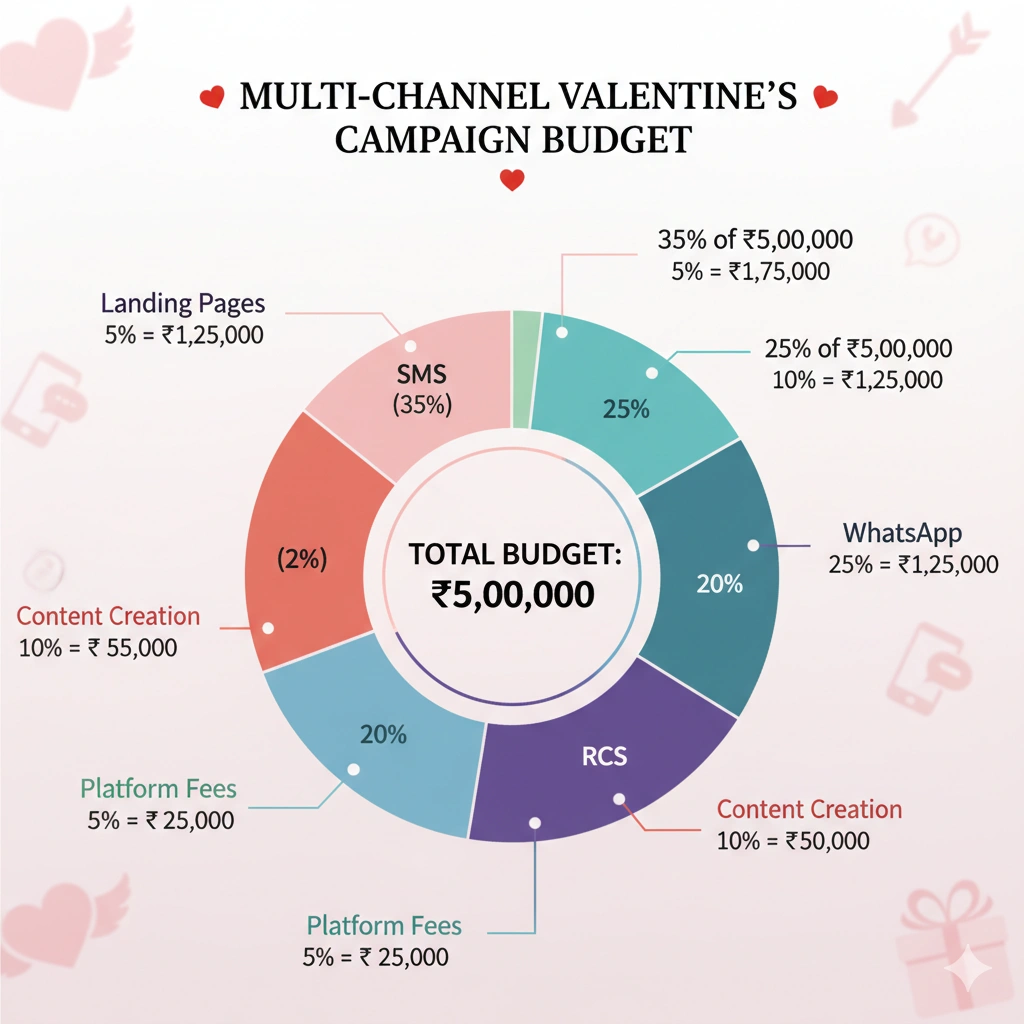
Budgeting Your Multi-Channel Campaign
Understanding costs helps you allocate resources effectively across channels:
Bulk SMS Costs: Promotional SMS in India costs ₹0.15-0.25 per message. For 100,000 messages, budget ₹15,000-25,000. Factor in short URL services (₹500-2,000/month) and landing page hosting.
WhatsApp Business API: Costs vary by message type. User-initiated conversations (customer messages you first) cost less (₹0.11-0.30 per conversation) than business-initiated ones (₹0.40-0.80). Budget for WhatsApp Business API access fees (₹5,000-15,000 initial setup).
RCS Messaging: Slightly premium than SMS at ₹0.30-0.50 per message due to rich features. For 50,000 RCS messages, budget ₹15,000-25,000. Consider design costs for creating carousel images and interactive elements.
Total Campaign Budget Example (Small Business):
- 50,000 SMS: ₹10,000
- 10,000 WhatsApp conversations: ₹5,000
- 20,000 RCS messages: ₹10,000
- Platform fees (SMSGatewayHub): ₹3,000
- Design and content creation: ₹5,000
- Total: ₹33,000
With average Valentine's Day conversion rate of 12-15% across channels and average order value of ₹1,500, this ₹33,000 investment could generate 9,000-12,000 sales worth ₹1.35-1.8 crores in revenue—a 400x+ ROI.
Common Mistakes to Avoid
Learn from these frequent pitfalls:
Mistake 1: Channel Cannibalization - Sending identical messages across all three channels simultaneously annoys customers. Solution: Stagger messages by 24-48 hours or target different segments per channel.
Mistake 2: Neglecting Mobile Optimization - 95% of message clicks happen on mobile, yet landing pages load slowly or display poorly. Solution: Test all landing pages on various devices before launch.
Mistake 3: Ignoring Response Management - Launching WhatsApp campaigns without adequate customer service staffing leads to frustrated customers. Solution: Implement chatbots for FAQs and ensure human agents handle complex queries within 30 minutes.
Mistake 4: Over-Complicating RCS - Creating overly complex RCS carousels with 10+ cards overwhelms customers. Solution: Limit to 5-7 cards maximum with clear, simple action buttons.
Mistake 5: Poor Segmentation - Broadcasting the same offer to all customers ignores their preferences and purchase capacity. Solution: Create at least 5 segments (new, loyal, high-value, inactive, price-sensitive) with tailored messaging.
Mistake 6: No Opt-Out Mechanism - Making it difficult to unsubscribe damages brand reputation and violates regulations. Solution: Include clear opt-out instructions in every message and honor requests immediately.
Mistake 7: Measurement Paralysis - Tracking 50 different metrics without clear KPIs leads to confusion. Solution: Focus on 5 core metrics per channel that directly correlate with revenue.
Valentine's Day 2026 offers extraordinary opportunities for businesses willing to embrace multi-channel marketing. By strategically combining Bulk SMS for reach, WhatsApp for engagement, and RCS for premium experiences, you create customer journeys that don't just drive sales—they build lasting relationships.
The businesses that win this Valentine's season won't be those with the biggest budgets, but those who understand how to orchestrate these three powerful channels into harmonious campaigns that meet customers exactly where they are with exactly what they need.
Start planning your multi-channel Valentine's campaign today, implement these proven strategies, and watch your sales reach unprecedented heights through the combined power of SMS, WhatsApp, and RCS marketing.
Ready to transform your business communication with reliable bulk SMS? Get started with SMSGatewayHub today—free demo available with custom pricing tailored to your messaging needs.
Contact smsgatewayhub now and get your first 1000 SMS credits free to test the platform!
Need personalized assistance? Our team at SMSGatewayHub is ready to help you navigate DLT registration and launch successful SMS campaigns. Get in touch today!
📧 support@smsgatewayhub.com | 📞 +91-9907922122 | 🌐 www.smsgatewayhub.com
Frequently Asked Questions (FAQs)
Q1: Should I use all three channels (SMS, WhatsApp, RCS) or can I start with just one?
Start with what your customers already use. If your database is primarily basic phone users, begin with Bulk SMS. If you have smartphone users who engage with your brand, add WhatsApp. Introduce RCS for premium product lines or tech-savvy segments. You can scale to all three channels over time, but one well-executed channel beats three poorly managed ones.
Q2: How do I decide which message goes through which channel?
Use this framework: Time-sensitive offers and flash sales → SMS (immediate delivery). Product inquiries, customer service, detailed conversations → WhatsApp. Premium products, interactive experiences, rich media showcases → RCS. Urgent order updates → SMS. Personalized recommendations → WhatsApp. Brand storytelling → RCS.
Q3: What's the ideal message frequency across all three channels during Valentine's season?
Combine all channels for a maximum of 6-8 messages throughout the entire Valentine's season (Feb 1-14). Example distribution: 3 SMS, 3 WhatsApp, 2 RCS. Never send messages from multiple channels on the same day to the same customer unless they're responding to inquiries. Space messages 24-48 hours apart.
Q4: How much should I budget for a multi-channel Valentine's Day campaign?
Small businesses: ₹25,000-50,000 (reaching 50,000-100,000 customers). Medium businesses: ₹1-3 lakhs (reaching 200,000-500,000 customers). Large enterprises: ₹5-15 lakhs (reaching 1 million+ customers). Budget includes messaging costs, platform fees, content creation, and landing pages. ROI typically ranges from 300-500x for well-executed campaigns.
Q5: Can I send Valentine's Day promotional messages on WhatsApp without customer consent?
No, WhatsApp strictly prohibits sending promotional messages without prior opt-in. Customers must initiate contact or explicitly opt in through your website, SMS, or in-store sign-ups. Violating this results in account suspension. Use WhatsApp only for customers who've consented, and use SMS for broader promotional reach.
Q6: What's the difference between RCS and regular SMS?
RCS (Rich Communication Services) is SMS's evolution, offering app-like features: high-resolution images, video, action buttons, carousels, read receipts, typing indicators, and verified sender badges. Regular SMS is text-only, 160 characters, no delivery confirmation. RCS provides 35-40% higher engagement but works only on compatible Android devices, while SMS reaches all phones.
Q7: How do I track ROI across three different channels?
Use unique promo codes per channel (SMS30, WHATS30, RCS30) and UTM-tagged URLs. Implement multi-touch attribution in Google Analytics to see customer journey across channels. Most importantly, use an integrated platform like SMSGatewayHub that provides unified dashboard analytics showing revenue, conversion rates, and ROI for each channel in one place.
Q8: Which channel has the highest conversion rate for Valentine's Day campaigns?
It varies by product and customer segment. Generally: SMS shows 10-15% conversion for time-sensitive offers, WhatsApp achieves 15-25% for personalized recommendations with conversation, RCS delivers 20-30% for premium products with rich media. Multi-channel campaigns that use all three strategically achieve 25-35% overall conversion—higher than any single channel alone.
Q9: Do I need separate teams to manage SMS, WhatsApp, and RCS campaigns?
Not necessarily. Small businesses can manage all three with 1-2 people using unified platforms. Medium businesses benefit from dedicated roles: campaign manager (strategy), content creator (messages), customer service (WhatsApp responses), and analyst (optimization). Large enterprises might have channel-specific teams. The key is using integrated tools that centralize management.
Q10: How early should I start planning my multi-channel Valentine's Day campaign?
Begin planning by mid-January (2 weeks before Valentine's month). This gives you time to: clean database, create content, design RCS carousels, set up WhatsApp chatbots, test workflows, and schedule messages. Launch awareness campaigns by February 1st. Businesses that start planning in late January often miss early-bird shoppers who purchase 10-14 days before Valentine's Day.