SMS Verification Guide 2026: How It Works & Why It's Essential
By: Senior Telecom Authentication Specialist (10+ years CPaaS, OTP infrastructure, RBI/TRAI compliance)

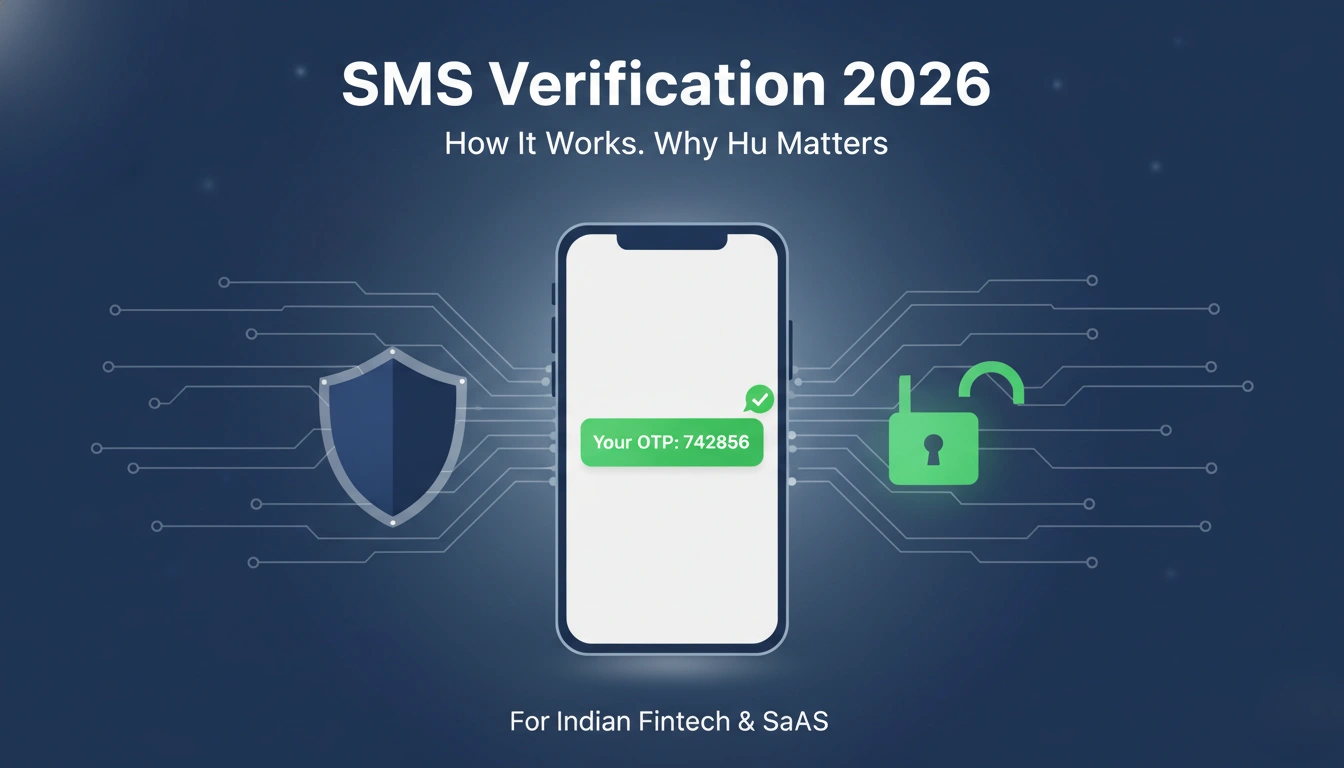
Introduction: Why SMS Verification Matters in 2026
India's fintech ecosystem is simultaneously booming and under siege. With ₹100+ lakh crores in annual UPI transaction volume and 500M+ smartphone users, the opportunity is massive. But so is the attack surface.
The Security Reality:
- Cybercrime incidents showed double-digit growth in 2023–2024 (as per industry reports)
- Account takeover (ATO) attacks remain the #1 fraud vector in fintech
- Regulatory bodies (RBI, TRAI, NITI Aayog) have made authentication mandatory, not optional
Why This Matters:
- RBI mandates 2FA for transactions >₹10,000 (Master Direction on Digital Payments, 2024)
- TRAI enforces DLT-compliant SMS routing (since 2021, still actively monitored)
- Non-compliance = License suspension + regulatory fines
- Customer trust directly correlates with adoption of 2FA (industry standard benchmark)
This guide covers how SMS verification works, realistic security trade-offs, modern threats you need to understand, and how to implement it correctly in 2026.
Read more- Complete TRAI DLT registration guide
What is SMS Verification?
SMS verification sends a unique 6-digit code (OTP) to a user's phone to confirm identity during critical actions: account signup, login, fund transfer, or password reset.
How SMS OTP Compares to Alternatives (2026 Reality):
| Method | Delivery Speed | Security Level | Accessibility | Cost | RBI Approved | 2026 Status |
|---|---|---|---|---|---|---|
| SMS OTP | <2 sec (direct routes) | High | 99.5% (feature phones work) | ₹0.50–2 | ✅ Mandated | Industry standard |
| WhatsApp OTP | 1–3 sec | High | 85% (needs internet) | ₹0.30–0.50 | ⏳ Testing | Growing mainstream |
| Email OTP | 1–5 sec | Medium-High | 95% (email access) | Free–₹0.10 | ✅ Approved (backup) | Reliable fallback |
| TOTP (Authenticator) | Instant | Very High | 70% (app install) | Free | ⏳ Discussion | Enterprise preference |
| Biometric | <1 sec | Very High | 50% (hardware) | Device-dependent | ⏳ Emerging | Mobile-only |
Reality Check (2026):
- SMS remains #1 because RBI legally requires it for fintech
- WhatsApp is growing but can't fully replace SMS (policy, regulatory uncertainty)
- No single method is "best"—layer them based on transaction risk
- Feature phone compatibility still matters: 200M+ users can't use WhatsApp reliably
How SMS Verification Actually Works (10 Steps)
Step 1–2: User Action → OTP Generation
User initiates action (login, payment, account recovery). Server generates cryptographically secure 6-digit code using crypto.getRandomValues() or equivalent. Critical: Never store plaintext OTP.
Step 3–4: OTP Hash & Gateway Request
- Server hashes OTP using SHA-256 before database storage
- Sends HTTPS POST to SMS provider (Twilio, Exotel, MSG91, Kaleyra) with:
- Pre-registered sender ID (6 chars: "MYBANK")
- Pre-approved template ID (TRAI requirement)
- Entity ID + Principal Entity ID (compliance proof)
- Gateway validates TRAI DLT compliance before sending
Cost per SMS: ₹0.50–₹2 depending on provider and volume
Step 5–6: Telecom Routing → Operator Delivery
- Direct operator routes (Jio, Airtel, Vodafone, BSNL): <2 second delivery
- Intelligent failover if primary route unavailable
- Real-time delivery reports via webhook callback
Step 7–8: User Receives → Enters Code
User sees: "Your OTP is 742856. Valid 2 minutes. Do not share."
Modern Android auto-fills (supported in 95% of apps). Other devices require manual entry.
Step 9–10: Server Validates with Multi-Layer Checks
Your backend validates in sequence:
1. Hash matching: hash(entered_otp) == stored_hash_value?
2. Expiration: current_time <= (creation_time + 60 seconds)?
3. Rate limiting: attempts_count < 3?
4. Device check: device_fingerprint matches trusted device?
5. Behavioral: geographic/velocity anomalies?
6. Account status: account not flagged/locked?
If all pass → create session, log event, grant access.
Why SMS Verification Is Essential in 2026
1. Regulatory Compliance (Non-negotiable)
RBI Mandate (Master Direction 2024):
- 2FA required for online fund transfers >₹10,000
- SMS OTP is explicitly listed as approved method
- Non-compliance = license suspension for regulated entities
TRAI DLT Framework:
- All transactional SMSes must use pre-registered sender IDs + templates
- 6-month audit trail mandatory
- Violations = SMS blocking + penalties up to ₹50,000 per message
- Real exposure: 100K SMS/month unregistered = ₹600 lakh annual fine risk
NITI Aayog e-KYC:
- SMS OTP approved for online KYC verification
- Enables digital-first onboarding without physical documents
2. Fraud Prevention
Account takeover (ATO) remains the #1 fraud vector in Indian fintech. Even with password stolen:
- Attacker needs physical phone possession to intercept SMS
- SIM swap is possible but difficult (requires social engineering + operator error)
- Rate limiting + device fingerprinting make brute-force impractical
Realistic Impact:
- Companies report 60–70% reduction in ATO incidents with proper SMS OTP implementation
- Cost of fraud prevented > Cost of SMS provider (₹2–5 lakh/year)
3. Customer Trust & Revenue Impact
2FA presence signals security investment to customers:
Example (₹10 Cr GMV eCommerce):
- Baseline conversion rate: 2.5% = ₹25 lakh revenue
- With SMS verification + trust signals: 3.0–3.25% = ₹30–32.5 lakh
- Net annual benefit: ₹5–7.5 lakh additional revenue
Login completion rates also improve (users feel account is protected).
4. Accessibility & Financial Inclusion
- 250M Indian users don't have smartphones
- SMS works on ₹1,200 feature phones
- No internet required (critical for rural areas)
- Reaching this market = competitive advantage
Check latest price list - Maximize ROI with our award-winning bulk SMS Sending platform
Modern Security Threats & Mitigation (2026 Context)
Threat #1: SIM Swap Fraud
How: Attacker calls telecom operator, impersonates user, transfers number to attacker's SIM.
2026 Context: Operators have improved controls, but social engineering still works at scale.
Mitigation:
- Device fingerprinting (flag logins from new devices)
- Email confirmation requirement for new devices
- Behavioral monitoring (alert on unusual activity)
- MFA layering (SMS + email + TOTP for high-value transactions)
Threat #2: Phishing & Social Engineering
How: User receives fake SMS/WhatsApp claiming to be from bank, shares OTP with attacker.
2026 Update: AI-generated voice calls ("Your account is blocked, confirm OTP") becoming more sophisticated.
Mitigation:
- User education ("Bank never asks for OTP")
- OTP expiry: 30–60 seconds (reduces exposure window)
- Never ask user for OTP in follow-up communication
- Rate limiting (3 attempts, then 5-minute lockout)
Threat #3: SS7 Vulnerability (Network-Level Interception)
Reality Check: Extremely rare (requires telecom infrastructure access), but technically possible. Less common than SIM swap or phishing in practice.
Mitigation (if you serve high-net-worth individuals):
- TOTP as secondary factor (device-bound, can't be intercepted)
- Device fingerprinting
- Geolocation checks (flag impossible location jumps)
Threat #4: Brute-Force OTP Guessing
How: Attacker rapidly tries all 1 million OTP combinations (000000–999999).
Mitigation (Standard, industry practice):
Max OTP attempts: 3 per OTP
Exponential backoff: 1st immediate, 2nd after 30s, 3rd after 5min
Account lockout: 30 minutes after 5 total failures
Captcha: Before OTP request (automated attack prevention)
Velocity monitoring: Flag 100+ failures from same IP/hour
Success rate with controls: ~0.1% (vs. 5–8% without controls)
Threat #5: Modern Attacks (Emerging 2026)
- AI-driven SIM swap: Using social engineering + AI voice cloning
- RCS exploitation: If RCS becomes mainstream, similar vulnerabilities
- Cross-channel attacks: Compromising email + phone simultaneously
Mitigation: Multi-factor approach (no single method is bulletproof)
Best Practices Implementation
Pre-Deployment Checklist
Technical Setup:
[✅] OTP expiry: 30–60 sec (sensitive), 120 sec (login)
[✅] OTP hashing: SHA-256, never store plaintext
[✅] Rate limiting: 3 attempts max, exponential backoff
[✅] Device fingerprinting: Validate on every verification
[✅] API security: HTTPS/TLS 1.2+, API key rotation quarterly
[✅] Webhook verification: HMAC-SHA256 signature validation
Compliance Setup:
[✅] TRAI DLT: Verify sender ID, template, entity ID registered
[✅] RBI mandate: Implement for >₹10,000 transactions
[✅] Audit logs: Maintain 90-day minimum retention
[✅] User notifications: Real-time alerts on OTP/login events
Monitoring Setup:
[✅] SMS delivery rate: Alert if drops below 98%
[✅] OTP success rate: Target 80%+, alert <70%
[✅] Failed OTP attempts: Flag if >5 per user/hour
[✅] Delivery latency: Alert if >10 seconds average
DLT Registration: Step-by-Step for All Operators
Airtel DLT Registration Guide
BSNL DLT Registration Guide
Jio DLT Registration Guide
VIL DLT Registration Process Guide
SmartPing DLT Registration Process Guide
Choosing Your SMS Provider (2026 Options)
What Matters Most:
| Criterion | Why | Red Flag |
|---|---|---|
| TRAI DLT Approval | Legal compliance | No Entity ID registry |
| 99%+ Delivery Rate | Reliability | <98% average rate |
| Direct Operator Routes | Speed + cost | Aggregator-only access |
| <5 sec Average Latency | User experience | >10 sec typical delivery |
| 24/7 Support | Crisis management | Email-only support |
| Transparent Pricing | Budget predictability | Hidden per-minute charges |
India-Specific Providers (2026):
- Global Leader: Twilio (99.95% uptime, excellent documentation, slower support response)
- India-Native: Exotel (fastest latency, best local support, TRAI-optimized)
- Budget Option: MSG91 (cost-effective for startups, good TRAI compliance)
Recommendation: Primary provider from India-Native (cost + speed), backup from Global (reliability fallback).
Conclusion: Build Your 2FA Foundation Right
SMS OTP isn't trendy—it's foundational infrastructure that 92% of Indian fintech already uses. In 2026, the question isn't "Should we implement SMS OTP?" but "How do we implement it correctly?"
The path forward:
- Choose TRAI-compliant provider (mandatory)
- Implement rate limiting + device fingerprinting (standard)
- Layer SMS with email + TOTP for high-risk operations (best practice)
- Monitor delivery rates + fraud patterns (ongoing)
- Update security strategy as threats evolve (annual review)
Next Steps:
- Fintech founders: Start TRAI DLT registration (process takes 1–2 weeks)
- Current users: Audit your OTP implementation against checklist above
- Security teams: Review threat landscape (SIM swap + phishing dominates, not SS7)
The fintech platforms that nail this foundation will build unshakeable customer trust. Those that cut corners will face regulatory penalties.
FAQ
Q1: What's the difference between SMS verification and OTP authentication?
A: OTP (One-Time Password) is the 6-digit code itself—randomly generated or time-based. SMS verification is the delivery method sending that code via text. Other delivery channels include email, authenticator apps, or push notifications. SMS is the regulatory standard in India because it works on feature phones without internet connectivity.
Q2: How long should SMS OTP remain valid?
A: Best practice: 30–60 seconds for sensitive operations (fund transfers >₹10,000, password resets), 120 seconds for general login or account recovery. Show countdown timer in UI to prevent user frustration. After expiry, users must request a fresh OTP.
Q3: Is SMS verification compliant with RBI and TRAI regulations?
A: Yes. RBI mandates 2FA for transactions >₹10,000 (Master Direction on Digital Payments, 2024). SMS OTP is explicitly approved. TRAI DLT compliance requires: pre-registered sender ID, pre-approved template, Entity ID verification, and 6-month audit trail. Non-compliance results in SMS blocking and penalties up to ₹50,000 per message.
Q4: What are the main security risks of SMS OTP?
A: Key risks: (1) SIM swap fraud (attacker transfers phone number), (2) Phishing (user tricked into sharing OTP), (3) Brute-force guessing (rapid OTP combination attempts), (4) SS7 vulnerability (network-level interception—rare), (5) Emerging AI-driven social engineering. Mitigation includes rate limiting, device fingerprinting, MFA layering, and behavioral monitoring.
Q5: What's the typical OTP delivery time in India?
A: With direct operator routes (Jio, Airtel, Vodafone), delivery averages <2 seconds. Secondary routes take 2–5 seconds. Reputable providers maintain 99%+ delivery rate. Consistent delays >5 seconds indicate network congestion or poor provider selection—switch providers if this persists.
👉 Get Free DLT Support | 👉 Talk to Bulk SMS Expert | 👉 Start Sending SMS Now
Contact SMSGatewayHub:
📞 Call: +91-9907922122
📧 Email: support@smsgatewayhub.com
🌐 Visit: www.smsgatewayhub.com